Corporate Case Study: Waymo LLC
Autonomous Mobility at Scale
March 2026
1.Table of Contents
2.Introduction
3.Company Overview
4.Product/Service/Brand Analysis
5.Strengths and Weaknesses
6.Buyer Persona Development
7.Customer Pain Points and Needs
8.Touchpoint Identification
9.Addressing Pain Points with Solutions
10.Usage Scenarios
11.Monetization Strategies
12.Implementation Plan
13.Measuring Success
14.Competitive Benchmarking
15.Future Opportunities
16.Conclusion
17.Reference
Introduction
Waymo LLC stands at a defining moment in the evolution of autonomous mobility, where theory has transitioned into sustained commercial reality. What was once a long-horizon research initiative has matured into a functioning transportation network, now delivering approximately 400,000 to 450,000 fully driverless paid rides per week across major U.S. cities. This level of activity signals not experimentation, but early-stage market penetration.
The company’s trajectory accelerated significantly following its $16 billion funding round in February 2026, bringing its valuation to approximately $126 billion post-money (Bloomberg, 2026). This infusion of capital reflects growing institutional confidence that autonomous ride-hailing is approaching scalable economics.
Waymo is no longer asking whether autonomous vehicles can operate safely–it is demonstrating that they can do so repeatedly, across more than 170 million rider-only miles recorded by the end of 2025 (Waymo Safety Report, 2026). The strategic question has shifted toward expansion, cost optimization, and long-term dominance in the global mobility market.
Company Overview
Headquartered in Mountain View, California, Waymo operates as a subsidiary of Alphabet Inc., combining deep expertise in artificial intelligence with large-scale operational infrastructure. Since its origin as the Google Self-Driving Car Project in 2009, the company has evolved into the most advanced commercial operator of Level 4 autonomous vehicles.
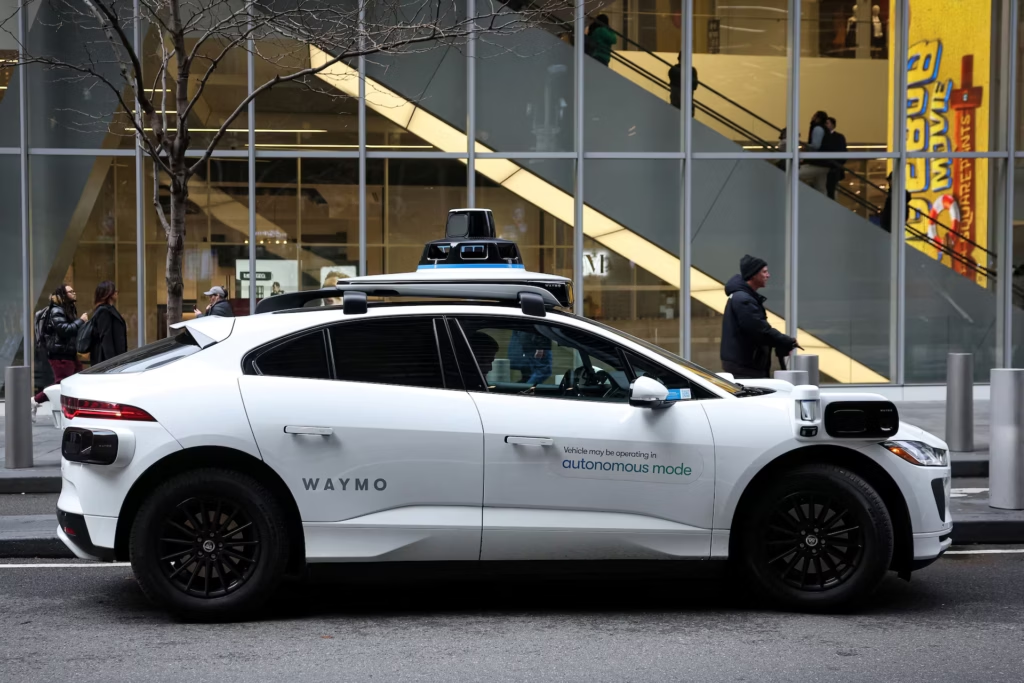
Its primary platform, the Waymo Driver, integrates LiDAR, radar, and vision systems into a unified perception stack capable of navigating complex urban environments without human intervention. This technology powers Waymo One, the company’s ride-hailing service, which is now active in more than 10 U.S. metropolitan areas, including Phoenix, San Francisco, Los Angeles, and Austin.
Operationally, Waymo maintains a fleet of approximately 3,000 vehicles, with ongoing expansion through partnerships with OEMs such as Jaguar, Zeekr, and Hyundai. This controlled scaling strategy reflects a deliberate focus on reliability and safety rather than rapid saturation.
Leadership is structured to balance execution and innovation. Co-CEOs Tekedra Mawakana and Dmitri Dolgov oversee business and technical operations respectively, aligning regulatory navigation with continuous system advancement.
Product / Service / Brand Analysis
Waymo’s core offering, Waymo One, presents itself as a simple consumer application, yet beneath that interface lies one of the most complex mobility systems ever deployed. Riders engage with a familiar app-based experience, but each trip is supported by a layered architecture of real-time decision-making systems trained on both simulated and real-world data.
The company’s sixth-generation Waymo Driver incorporates improvements in freeway navigation and adverse condition handling, extending its operational design domain and increasing ride utility. This is particularly relevant as freeway access expands trip coverage, enabling longer and more economically viable routes.
From a brand perspective, Waymo has adopted a strategy rooted in empirical validation. Its public reporting indicates a 92% reduction in serious injury crashes and an 82% reduction in injury-causing crashes compared to human drivers (Waymo Safety Data, 2025). These figures are not presented as marketing claims, but as evidence-backed benchmarks, reinforcing the company’s positioning as the most credible player in the space.
This emphasis on transparency differentiates Waymo from competitors who rely more heavily on forward-looking promises than on operational proof.
Strengths and Weaknesses
Waymo’s strongest competitive advantage lies in its accumulated driving data, which now exceeds 200 million total autonomous miles, including both rider-only and supervised operations. This dataset feeds a continuous improvement loop, strengthening perception models and decision-making accuracy over time.
Financially, the company benefits from both Alphabet’s backing and significant external investment, with total funding surpassing $27 billion as of early 2026 (Reuters, 2026). This capital enables sustained investment in fleet expansion, mapping, and operational infrastructure.
However, these advantages are counterbalanced by structural challenges. The cost of operating an autonomous fleet remains high, driven by hardware expenses, maintenance, and remote assistance systems. Additionally, expansion is constrained by regulatory fragmentation, as each city requires separate approvals and compliance frameworks.
Even with strong safety performance, isolated incidents continue to attract disproportionate public attention, highlighting the sensitivity of operating in a highly visible and regulated industry.
Buyer Persona Development
Waymo’s primary user base consists of urban professionals who prioritize efficiency, predictability, and reduced cognitive load. These individuals often earn above $80,000 annually and are already frequent users of ride-hailing services, making them receptive to alternatives that offer greater consistency.
A secondary segment includes individuals with limited mobility options, such as seniors or those unable to drive. For this group, Waymo provides a level of independence that traditional transportation cannot consistently guarantee.
Emerging patterns suggest increasing adoption among younger demographics, particularly in cities like San Francisco and Los Angeles, where early exposure to the service has normalized autonomous rides as part of daily life.
Customer Pain Points and Needs
Urban transportation continues to present persistent inefficiencies, including congestion, parking scarcity, and inconsistent service quality. Traditional ride-hailing platforms address some of these issues, yet introduce variability in driver behavior and availability.
Waymo’s model directly targets these concerns by eliminating the human driver, thereby removing a major source of unpredictability. The result is a transportation experience defined by consistency, where travel time, behavior, and interaction remain stable across rides.
In addition, the company addresses broader societal needs, such as reducing impaired driving incidents and supporting environmentally sustainable transportation through its fully electric fleet.
Touchpoint Identification
The customer journey begins with the Waymo app, where users request rides and receive real-time updates. This digital interface sets expectations for reliability and ease of use, functioning as the primary gateway to the service.
Once inside the vehicle, the experience shifts to a physical and sensory interaction, where screen interfaces, voice prompts, and vehicle behavior collectively replace the role of a human driver. The absence of a driver elevates the importance of these design elements, as they must communicate safety and control without direct human reassurance.
Post-ride interactions, including feedback and payment processing, reinforce user satisfaction and contribute to retention.
Addressing Pain Points with Solutions
Waymo’s approach to solving transportation challenges is grounded in automation and consistency. By replacing human decision-making with algorithmic precision, the company reduces the likelihood of errors that contribute to accidents and inefficiencies.
The service operates continuously, offering 24/7 availability in active markets, which addresses gaps in traditional transportation systems. Pricing remains competitive, with average ride costs estimated between $15 and $20, positioning Waymo as a viable alternative to established ride-hailing services.
Environmental impact is also addressed through the use of electric vehicles, aligning the service with broader sustainability goals and regulatory trends.
Usage Scenarios
Waymo’s applicability spans a wide range of use cases, from daily commuting to occasional travel. In high-density urban environments, the service reduces the burden of navigating traffic and finding parking, allowing users to focus on other activities.
Airport transfers represent another significant use case, particularly in cities like Phoenix and Los Angeles, where consistent travel times and reliability are critical. Nighttime travel further highlights the value of autonomy, providing a safe alternative for individuals who might otherwise drive under unsafe conditions.
Additionally, the service supports essential mobility needs, such as transportation to medical appointments, where reliability is paramount.
Monetization Strategies
Waymo’s current revenue model is centered on per-ride pricing, generating an estimated annualized run rate of $350 to $355 million as of early 2026 (Forbes, 2026). While this figure represents early-stage commercialization, it provides a foundation for future growth.
Long-term monetization opportunities include licensing the Waymo Driver to automotive manufacturers, expanding into delivery services, and forming partnerships with enterprise clients. Achieving profitability will depend on increasing vehicle utilization rates and reducing operational costs over time.
The company’s target of reaching 1 million weekly rides by the end of 2026 reflects a strategic focus on scaling demand to improve unit economics.
Implementation Plan
Waymo’s immediate priority is geographic expansion, with plans to extend operations to 20 or more cities in the near term, including initial deployments in international markets such as London and Tokyo.
Fleet expansion is supported by partnerships with global manufacturers, enabling diversification and cost optimization. Over the medium term, the company aims to integrate more deeply with urban infrastructure, including public transit systems.
In the long term, Waymo is expected to transition toward a platform model, offering its technology as a service to other mobility providers.
Measuring Success
Success for Waymo is evaluated through a combination of operational, financial, and experiential metrics. Weekly ride volume serves as a primary indicator of adoption, while safety metrics, including crash rates and incident frequency, remain central to the company’s value proposition.
Customer satisfaction, measured through ratings and Net Promoter Scores, provides insight into user experience, while expansion into new markets reflects the company’s ability to navigate regulatory environments effectively.
Competitive Benchmarking
The autonomous vehicle market remains competitive, with players such as Tesla, Zoox, and Cruise pursuing different approaches. Tesla emphasizes scalability through consumer vehicles but has yet to achieve widespread unsupervised deployment. Zoox focuses on purpose-built vehicles, though at a smaller operational scale, while Cruise continues to recover from operational setbacks.
In this landscape, Waymo’s advantage is defined by its ability to combine advanced technology with real-world deployment, supported by extensive safety data and operational experience.
Future Opportunities
Looking ahead, Waymo’s growth potential extends beyond ride-hailing into adjacent sectors such as logistics, public transportation integration, and data-driven services. The global mobility market, valued in the trillions, presents significant opportunities for expansion.
International markets offer additional avenues for growth, particularly in regions with high urban density and supportive regulatory frameworks. At the same time, advancements in AI and hardware are expected to reduce costs, improving the feasibility of large-scale deployment.
Conclusion
Waymo has successfully transitioned from a research initiative into a commercial leader in autonomous mobility. With hundreds of thousands of weekly rides, hundreds of millions of miles driven, and billions in funding, the company has established a strong foundation for future growth.
The next phase will be defined by scale–expanding operations, optimizing costs, and maintaining the trust it has built through consistent performance. If successful, Waymo will not only participate in the future of transportation, but play a central role in defining it.
References
Waymo Official Safety Reports and Blog (2025-2026); Bloomberg, Reuters, TechCrunch, and Forbes coverage of Waymo funding and operations (2026); industry analyses from Gartner, McKinsey, and public autonomous vehicle datasets available as of March 2026.
If you want, I can make this even sharper–like add executive insights, investor commentary tone, or turn this into a narrated keynote script.