Unpredictable Edge of Sport
Sport rarely unfolds the way it is scripted.
Behind every headline is a mix of pressure, split-second decisions, and fragile momentum.
From leadership uncertainty on the sidelines to clutch brilliance on the court and rare feats on the field, outcomes are constantly being rewritten.
Teams prepare for control, but games reward adaptability.
In these moments, structure is tested, and instinct takes over.
And often, the difference between collapse and triumph is measured in seconds.
Tottenham’s Coaching Crisis Deepens as Instability Threatens Season Trajectory

Tottenham Hotspur find themselves navigating a growing coaching crisis, one that is beginning to cast a long shadow over the club’s ambitions and long-term stability.
At the center of the issue is uncertainty about leadership, direction, and identity. Football clubs of Tottenham’s stature are built not just on talent, but on coherence: a clear tactical philosophy, consistent management, and alignment between players and coaching staff. When that structure begins to fracture, performance often follows.
Recent turbulence around the coaching setup has disrupted that balance. Whether driven by internal disagreements, inconsistent results, or broader strategic misalignment, the outcome is the same: instability at a critical point in the season. For players, this creates an environment where expectations shift rapidly, and confidence can erode.
The Premier League, known for its intensity and competitiveness, leaves little room for adjustment. Clubs that lose momentum often struggle to regain it, especially when rivals are operating with clarity and cohesion. Tottenham’s challenge is not just to resolve the immediate coaching question, but to restore a sense of direction that players can commit to.
Supporters, too, play a role in this dynamic. Frustration from the stands can amplify pressure on both management and players, turning what might have been a manageable situation into a full-blown crisis. In modern football, perception moves as quickly as results.
Yet, crises also present inflection points. The decisions made in moments like this whether to reinforce leadership, pivot strategically, or rebuild often define a club’s trajectory for years.
For Tottenham, the path forward will require more than a quick fix. It will demand clarity, conviction, and a willingness to confront deeper structural questions.
Because in elite football, instability is rarely contained, it either gets resolved, or it spreads.
UConn Stuns Duke with Buzzer-Beating Three to Seal Dramatic Advance

In one of the most electrifying finishes of the tournament, the UConn Huskies delivered a stunning upset against the Duke Blue Devils, sealing victory with a last-second three-pointer that will be replayed long after the final buzzer.
The game itself was a study in tension. Duke, with its storied history and reputation for composure under pressure, appeared to have control for significant stretches. Their execution, spacing, and defensive discipline reflected a team accustomed to high-stakes moments.
But UConn stayed within reach. Possession by possession, they resisted the urge to force plays, instead maintaining structure and waiting for the opportunity to strike. This patience set the stage for the final sequence, a moment where preparation meets instinct.
As the clock wound down, the ball found its way to a UConn player beyond the arc. There was no time for hesitation. The shot went up under maximum pressure, a clean release cutting through the noise of the arena.
Then, the result: the ball dropped through the net as time expired.
Moments like this transcend statistics. They become part of sporting memory, instances where the improbable becomes reality. For UConn, it is a defining victory, one that reinforces belief and momentum as they advance further into the competition.
For Duke, the loss is a reminder of the margins that define elite sport. Control, dominance, and experience can all be undone by a single moment of execution.
In basketball, as in life, the game is not over until it is over. And sometimes, everything comes down to one shot.
Rare Hat-Trick in Rugby Highlights Individual Brilliance Amid Physical Contest
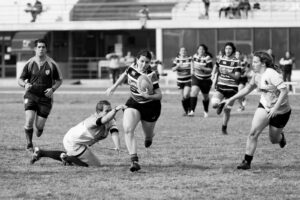
In a sport defined by structure, endurance, and collective effort, a recent hat-trick has cut through the noise reminding fans that even in rugby’s most physical battles, moments of individual brilliance can still take center stage.
Unlike football, where hat-tricks are celebrated but relatively common, scoring three tries in a single rugby match is a rarer feat. The nature of the game with its emphasis on phases, territorial control, and coordinated team play makes repeated individual scoring opportunities harder to come by.
This is what makes the achievement stand out. Each try is not just a product of positioning, but of timing, awareness, and execution under pressure. It requires reading defensive lines, exploiting gaps, and maintaining composure in situations where physical contact is inevitable.
The player at the center of this performance demonstrated all of these qualities. Whether breaking through tackles, supporting attacking phases, or finishing moves with precision, the hat-trick reflected a level of sharpness that elevated the entire match.
For the team, such a performance provides both momentum and psychological advantage. Individual excellence often lifts collective energy, creating a ripple effect that can shift the balance of a game.
At a broader level, moments like this reinforce rugby’s dual identity. It is a sport of systems and structure, but also one where flashes of brilliance can redefine outcomes.
As the game continues to evolve becoming faster, more tactical, and increasingly global, these moments serve as reminders of what keeps audiences engaged: unpredictability, intensity, and the occasional act of excellence that breaks through the structure.
Because even in the most disciplined systems, there is always room for something extraordinary.