From Energy Breakthroughs to Humanitarian Closure, States Confront Pressure on Multiple Fronts
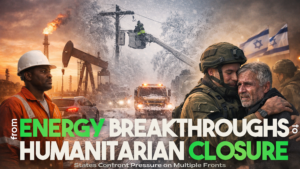
Nations are navigating moments where opportunity and crisis intersect.
Economic promise is emerging even as climate and security pressures intensify.
Governments are being tested on preparedness, credibility, and response speed.
In energy, weather, and conflict, outcomes hinge on institutional coordination.
Together, these stories reveal how state capacity is measured in real time.
Nigeria’s New Oil Discovery Rekindles Economic Optimism and Policy Debate

Nigeria’s announcement of a new oil discovery has injected cautious optimism into Africa’s largest economy. At a time when fiscal pressures, currency volatility, and declining production have weighed heavily on public confidence, the discovery offers a potential pathway toward renewed revenue generation and energy relevance.
Officials described the find as commercially significant, with reserves capable of strengthening Nigeria’s upstream portfolio if developed efficiently. For a country whose budget and foreign exchange earnings remain deeply tied to hydrocarbons, the implications are substantial. Increased production could ease pressure on government finances and stabilize external accounts.
However, the discovery also reopens long-standing debates about dependency. Critics argue that Nigeria’s repeated reliance on oil windfalls has historically delayed diversification, leaving the economy vulnerable to global price shocks. The challenge, they say, is not discovering oil but translating it into sustainable development.
Security and infrastructure concerns loom as well. New discoveries require substantial investment, regulatory clarity, and protection from sabotage in regions where oil assets have historically been targets. Without reforms to governance and community engagement, production timelines could face delays.
The discovery arrives amid a global energy transition that complicates long-term planning. While oil demand persists, investors are increasingly selective, prioritizing jurisdictions with regulatory stability and low production risk. Nigeria’s ability to attract capital will depend on policy consistency as much as geology.
Ultimately, the new oil find is best viewed as an opportunity rather than a solution. Whether it becomes a catalyst for broader economic reform or another missed chance will depend on how decisively Nigeria aligns resource wealth with long-term national strategy.
Severe US Winter Storm Exposes Infrastructure Vulnerabilities and Emergency Strain

A powerful winter storm sweeping across large parts of the United States has triggered widespread disruption, testing emergency response systems and infrastructure resilience. Heavy snowfall, freezing temperatures, and ice accumulation have led to power outages, travel shutdowns, and mounting safety concerns across multiple states.
Transportation networks were among the hardest hit. Airports canceled thousands of flights, highways became impassable, and rail services faced delays. For millions of residents, daily routines were abruptly suspended, highlighting how weather extremes can paralyze modern logistics.
Energy infrastructure also came under pressure. Power grids strained under surging demand for heating while ice and wind damaged transmission lines. Utilities raced to restore service, but prolonged outages raised questions about grid hardening and preparedness for increasingly frequent extreme weather events.
Local and federal authorities activated emergency protocols, opening shelters and issuing travel advisories. Yet the scale of the storm exposed gaps in coordination, particularly in rural areas where response times were slower and resources limited.
The storm has intensified policy discussions around climate resilience. While winter weather is not new, its increasing severity and unpredictability have renewed calls for infrastructure upgrades, including weatherized power systems and more robust emergency planning.
Beyond immediate recovery, the crisis underscores a broader reality: climate volatility is no longer episodic but structural. The ability of governments to protect lives and economic activity during such events is becoming a defining measure of governance capacity.
Israel Recovers Last Gaza Hostage, Marking a Somber Turning Point

Israel’s recovery of the last remaining hostage from Gaza has brought a deeply emotional chapter to a close, offering a measure of resolution after months of uncertainty. The development carries profound humanitarian, political, and symbolic weight within a conflict defined by loss and prolonged tension.
For families and communities, the recovery represents closure after sustained anxiety. Hostage situations occupy a unique psychological space in conflict, blending personal trauma with national anguish. The return of the final captive has resonated widely across Israeli society.
The operation itself underscored the complexity of conflict-zone negotiations and recovery efforts. Whether achieved through military action, intelligence coordination, or diplomatic channels, such outcomes reflect months of pressure, calculation, and risk management.
Politically, the recovery shifts the narrative. Attention may now move from hostage negotiations toward broader questions of conflict resolution, accountability, and the humanitarian toll on civilians across the region.
Internationally, the event has prompted renewed scrutiny of the war’s conduct and its aftermath. Allies and critics alike are reassessing their positions as the conflict enters a new phase defined less by immediate rescue efforts and more by long-term consequences.
While the recovery of the last hostage does not resolve the conflict itself, it closes a painful chapter. It stands as a reminder that even amid geopolitical struggle, individual lives remain central to the moral weight of war.