Blaksolvent Ai News 12th May 2026
May 12, 2026
6 min read
The Near-Trillion Dollar Race: Capital, Geopolitics, and the Limits of Growth
Artificial intelligence is being stress-tested at every level — money, power, and public trust.
Anthropic is closing in on a near-trillion dollar valuation as AI funding reaches historic scale.
Trump and Xi are sitting across a table in Beijing with the future of AI dominance on the agenda.
The $725 billion infrastructure buildout is hitting a wall — and it’s not made of silicon.
A new YouGov poll shows twice as many Americans are AI pessimists as optimists.
These stories show the gap between AI’s ambition and the world it has to live in.
Anthropic Inches Toward a $950 Billion Valuation — The AI Funding Machine Has No Ceiling
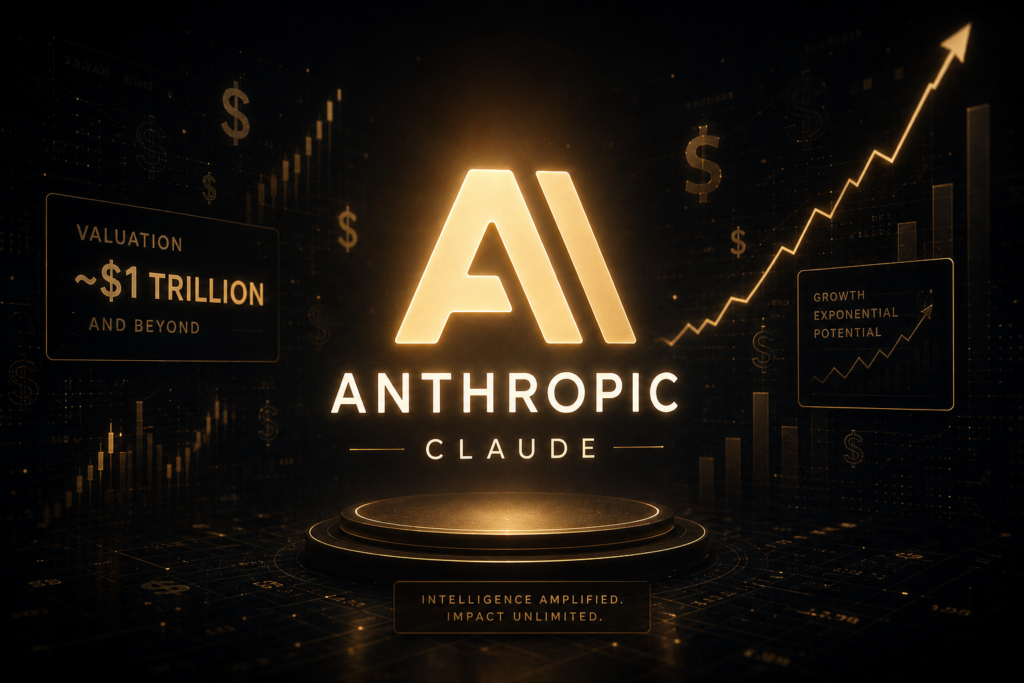
Anthropic, the San Francisco-based AI safety company behind the Claude model family, is in active talks with investors to raise between $30 billion and $50 billion in new funding at a reported valuation approaching $950 billion. If completed at that figure, Anthropic would become one of the most valuable private companies in history — sitting just below the trillion-dollar threshold that only a handful of publicly traded companies have ever crossed.
The numbers behind this funding round are not accidental. Anthropic’s revenue trajectory has been extraordinary: from $1 billion annualized in late 2024, to $9 billion by end of 2025, to $14 billion by February 2026. That growth rate — described by CEO Dario Amodei as an 80x increase — signals that enterprise and government adoption of Claude is accelerating far beyond early projections. Investors who once questioned whether foundation model companies could build durable revenue are getting their answer.
The structural story is equally significant. Anthropic has reportedly secured a deal to run its Claude models on SpaceXAI’s Colossus 1 supercomputing facility, gaining access to more than 300 megawatts of capacity and over 220,000 Nvidia GPUs. This is not a company patching together compute — it is locking down the physical infrastructure needed to train and deploy the next generation of frontier models at scale. In a race where compute availability is a hard ceiling on capability, Anthropic is building a floor others will struggle to reach.
The funding round also carries a geopolitical dimension. Reports confirmed this week that China attempted to access Anthropic’s newest AI models — and was denied. For a company that built its identity around AI safety and responsibility, the decision to restrict access to adversarial state actors signals an awareness that frontier AI is no longer just a product — it is a strategic asset with national security implications. That framing will only strengthen the case for government contracts, defense partnerships, and regulatory goodwill in Washington.
What this moment reveals about the broader industry is worth pausing on. The AI funding cycle is not cooling — it is intensifying. As Anthropic approaches a $950 billion valuation while still private, it reflects a market consensus that the foundation model layer of the AI stack could be among the most valuable commercial infrastructure built in human history. Whether that consensus holds as models commoditize and competition deepens remains the defining question of the next 18 months.
Trump and Xi Meet in Beijing With the Future of AI in the Room
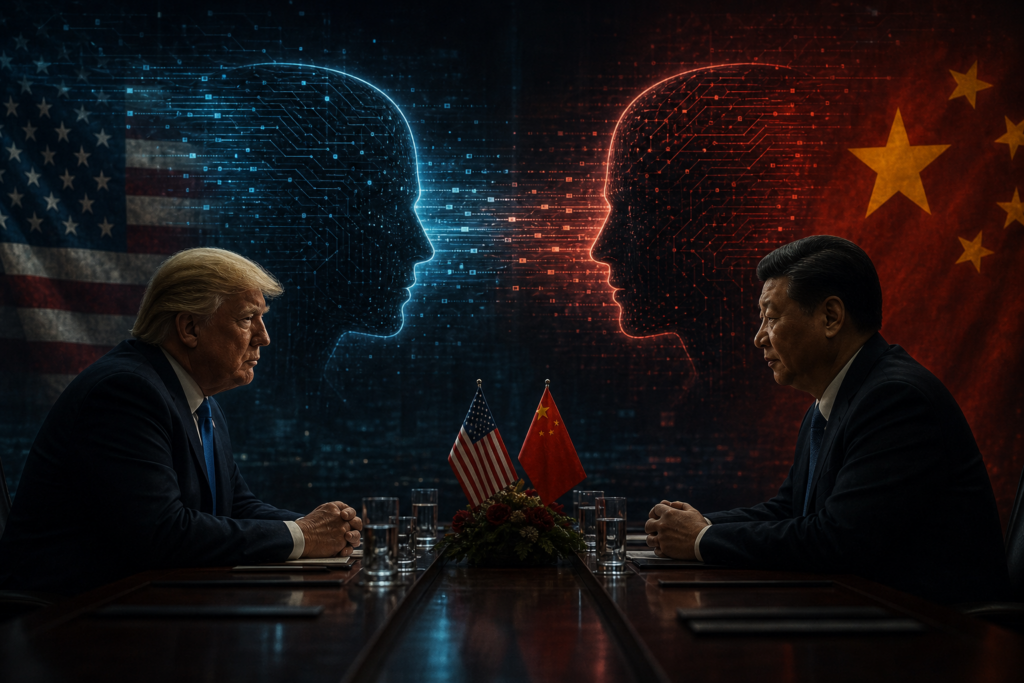
President Donald Trump arrived in Beijing this week to meet with Chinese President Xi Jinping — and while trade tariffs and Taiwan remain on the agenda, analysts from the Brookings Institution to Georgetown University are clear about what makes this meeting historically unusual: artificial intelligence is now as central to U.S.-China strategic competition as nuclear weapons were to the Cold War.
The AI race between the world’s two largest economies has reached what experts are calling a critical juncture. For years, the U.S. maintained a measurable lead in foundation model quality, compute access, and private sector investment. That narrative has grown more complicated. Stanford University’s 2026 AI Index Report, released last month, reached a stark conclusion: the performance gap between U.S. and Chinese AI models has effectively closed. DeepSeek’s R1 model — released in January 2025 at a fraction of the cost of comparable American systems — sent Nvidia and Broadcom stocks plunging 17% in a single trading day and forced a fundamental reassessment of the West’s assumptions about AI cost and capability.
The two countries, however, are not racing toward the same finish line. The United States, led by companies like Anthropic, OpenAI, and Google DeepMind, is focused on achieving Artificial General Intelligence — systems capable of replicating human-level reasoning across disciplines — and maintaining qualitative supremacy through better models and higher-impact research. China’s approach is structurally different. Beijing is prioritizing AI integration at industrial scale: deploying AI across manufacturing, education, healthcare, government services, and military logistics. Where America bets on the breakthrough, China bets on the rollout.
U.S. officials say Trump and Xi are expected to discuss AI security — specifically the risks that emerge when both sides race forward without coordinating on safety guardrails. That conversation matters because, as researchers at the Brookings Institution note, the lack of trust between Washington and Beijing is creating a “race to the bottom” on AI safety. Each side fears that slowing down for responsible deployment means ceding ground to the other. The result is a dynamic where the most powerful AI systems in history are being built by two superpowers that are not talking to each other about what happens if something goes wrong.
The outcome of this week’s meeting will not resolve that tension. But the fact that AI security is now a presidential-level diplomatic agenda item — alongside nuclear and trade policy — marks a turning point in how the world’s most powerful governments understand the stakes of the technology they are racing to dominate.
AI’s Infrastructure Boom Meets Its Match — The Real Bottleneck Isn’t Chips
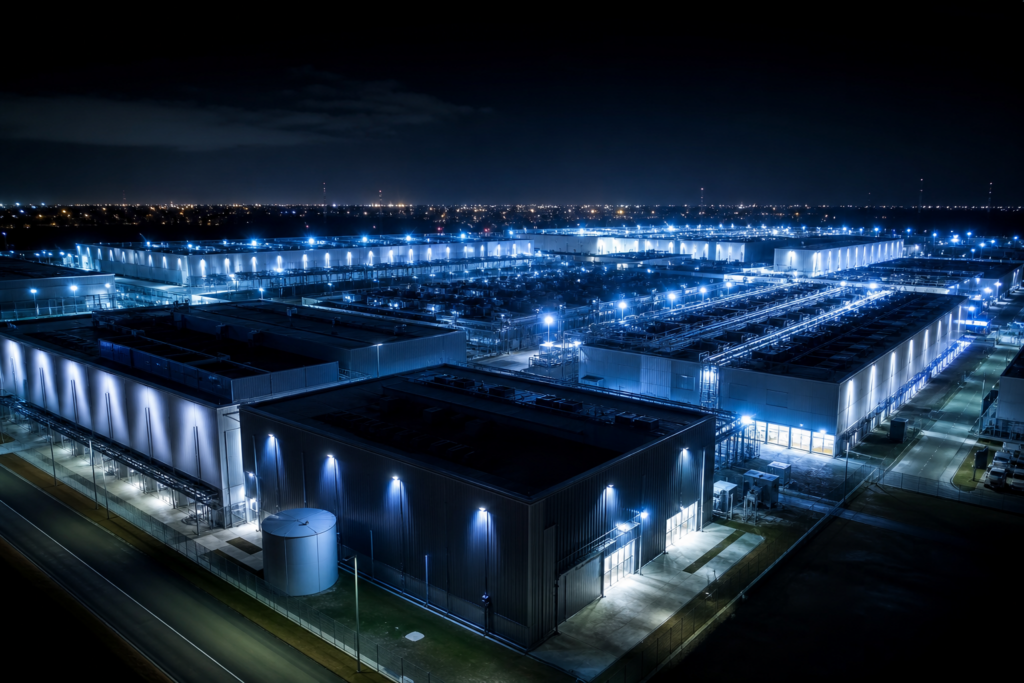
The Big Four hyperscalers — Microsoft, Amazon, Alphabet, and Meta — are projected to spend a combined $725 billion on AI infrastructure in 2026 alone. That spending is reshaping entire industries: chipmakers like Nvidia and AMD are supply-constrained, utilities are suddenly growth stocks, copper miners are running full capacity, and data center construction has become the most capital-intensive building boom in a generation. Wall Street analysts are comparing the AI infrastructure moment to the construction of America’s railroads. The analogy is apt — and so is the friction.
A new bottleneck is forming that no amount of capital can easily solve. Communities across America are pushing back against the scale of AI data center projects, and the opposition is becoming organized. In Utah, Kevin O’Leary’s proposed Stratos Project — a 40,000-acre AI campus backed by approximately $1 billion — has drawn sharp criticism from residents and environmental scientists. A Utah State University professor noted that the facility could generate thermal output equivalent to 23 atomic bombs per day in waste heat. In Virginia, the world’s largest data center market, residents have protested new construction over power consumption and land use. Similar resistance is emerging in Arizona, Georgia, and Texas.
The economics of this backlash are not symbolic — they are material. A single hyperscale AI data center can require more than 1 gigawatt of electricity, roughly the power needs of hundreds of thousands of homes. In drought-prone regions like Utah and Arizona, water consumption for cooling systems draws direct competition with agricultural and residential needs. When communities notice that utility infrastructure is being redirected from households to server farms, the politics shift quickly.
For investors and operators, this represents a structural risk that is underpriced in current AI infrastructure enthusiasm. Project delays caused by local opposition, permitting battles, environmental reviews, and grid negotiations can add years to construction timelines and hundreds of millions in carrying costs. A one-year delay on a multibillion-dollar AI campus ripples through semiconductor orders, cloud deployment schedules, and model training timelines in ways that are difficult to model but very real. The companies best positioned in this environment will be those that either build in communities that welcome the investment, partner with utilities early, or develop on-site renewable power capacity that reduces dependence on local grids.
The deeper truth here is that AI’s growth story has collided with physical reality. For a decade, the technology industry operated in a digital world where scaling felt frictionless. Data centers are a reminder that every token generated, every model trained, and every inference served requires land, water, electricity, and community tolerance. The companies that treat those constraints as engineering problems to solve — rather than political inconveniences to manage — will be the ones still building at scale in 2030.
Written by Blaksolvent News | blacksolvent.com/news | Blaksolvent Dept — Industry Reports