BLACKSOLVENT GÉNÉRAL NEWS | 16TH SEPTEMBER,2025
Power, Policy, and Pressure: A Defining Week in the Global Economy
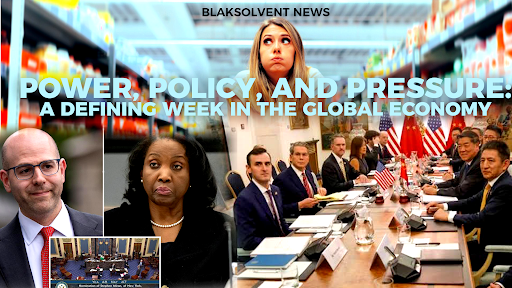
In a week that underscores the delicate balance between economics, politics, and global power, three developments have captured the world’s attention. At home, American households are growing more anxious as consumer confidence dips for a second month, weighed down by inflationary pressures and tariff worries. In Washington, the Senate’s confirmation of Stephen Miran to the Federal Reserve Board and a court battle over Lisa Cook’s seat highlight the deepening clash over the central bank’s independence. And abroad, high-level negotiations in Madrid have pushed forward a landmark agreement between the United States and China over the future of TikTok’s U.S. operations, a deal that could redefine the intersection of technology, national security, and international trade. Together, these stories reveal an economy under pressure, institutions under test, and a digital frontier caught between rival powers.
US Consumer Sentiment Declines for Second Month Amid Inflation and Tariff Concerns
BY BLAKSOLVENT NEWS
Consumer confidence in the United States weakened again in September, falling for the second straight month as households grew more concerned about inflation, tariffs, and the broader economic outlook.
According to the University of Michigan’s latest Surveys of Consumers, the sentiment index dropped to 55.4 in September from 58.2 in August, the lowest level since May and below economists’ expectations of 58.0. Both current and future financial outlooks worsened, with respondents citing tighter household budgets and growing worries about job security.
Inflation remained a key factor in the decline. Short-term inflation expectations held steady at 4.8%, while long-term expectations rose to 3.9%, up from 3.5% in August. Many households anticipate higher prices in the months ahead, a trend that could weigh on consumer spending as the holiday season approaches.
Trade policy and tariffs also played an outsized role in shaping sentiment. Nearly 60% of respondents mentioned tariffs without prompting, reflecting widespread concern that new trade measures will push up costs and erode purchasing power. Businesses are also grappling with uncertainty, adding to unease among workers and investors alike.
Economists warn that sustained declines in consumer sentiment could pose a risk to economic growth, as households account for more than two-thirds of U.S. activity. Lower- and middle-income families reported the sharpest declines, underscoring the uneven burden of inflation and tariff-related price pressures.
The data suggests that policymakers, including the Federal Reserve, face growing pressure to balance inflation management with measures to maintain consumer confidence and spending.
Senate Confirms Stephen Miran to Federal Reserve Board as Court Blocks Trump’s Effort to Oust Lisa Cook
By BLAKSOLVENT NEWS
In a rapidly unfolding challenge to the independence of the U.S. central bank, the Senate has narrowly confirmed Stephen Miran, President Donald Trump’s economic adviser, to a seat on the Federal Reserve’s Board of Governors. At the same time, a federal appeals court denied the White House’s attempt to remove Fed Governor Lisa Cook, allowing her to retain her position ahead of a major policy meeting.
The Senate voted 48–47 largely along party lines to approve Miran’s nomination, increasing Trump’s influence over the Federal Reserve just as the central bank prepares to meet on interest rates. Miran fills the vacancy left by Adriana Kugler, who resigned abruptly in August, and will serve the remainder of her term, which expires in January 2026. One controversial aspect of his appointment is his concurrent role as Chair of the White House’s Council of Economic Advisers. While he pledged to take unpaid leave from that job if confirmed, he will remain officially in the position a move Democrats criticized as an unacceptable conflict of interest.
Meanwhile, a U.S. Court of Appeals for the D.C. Circuit ruled against the Trump administration’s effort to remove Lisa Cook, a governor appointed under President Biden. The court’s decision means Cook may stay on the Board during the upcoming policy meeting. The administration had cited allegations of mortgage application misconduct before her confirmation, including claims that Cook improperly declared more than one residence as primary. Cook strongly denied the allegations and argued that, even if true, they do not meet the legal standard for removal under existing statutes, which allow governors to be dismissed only “for cause.”
Judge Jia M. Cobb had earlier issued an injunction blocking her removal, and in a 2–1 decision, appeals court judges appointed by Biden agreed that Cook’s due process rights were violated because she was not given adequate opportunity to respond to the allegations. The Trump administration is expected to appeal the ruling, potentially setting up a Supreme Court battle.
These twin developments come at a sensitive moment for U.S. monetary policy. The Federal Reserve is set to decide whether to cut interest rates in response to persistent inflation and signs of weakness in the labor market. Miran’s arrival may tilt the Board toward favoring aggressive rate cuts, a position long advocated by Trump. His dual roles as both Fed governor and White House adviser are expected to intensify scrutiny of the central bank’s independence.
The legal fight over Cook also has long-term implications. Never before has a president attempted to remove a sitting Fed governor under such circumstances, and the case could shape how “for cause” provisions are interpreted in the future. For now, Cook will remain in her post, and Miran will join the Board in time for the Fed’s upcoming two-day meeting, a gathering that economists, markets, and policymakers will be watching closely for signs of how political pressures may shape the direction of U.S. monetary policy.
US and China reach commercial terms for sale of TikTok’s U.S. operations after high-level negotiations in Madrid
BY BLAKSOLVENT NEWS
After two days of critical trade negotiations in Madrid, U.S. and Chinese officials say they have reached a framework agreement that would shift control of TikTok’s U.S. operations to an American-controlled entity, a move designed to address intense national security concerns.
Treasury Secretary Scott Bessent made the announcement, saying that “commercial terms have been agreed upon” by private parties, though he declined to share the specific details. He stressed that the deal aims to safeguard national security while still preserving some of TikTok’s features that China considers culturally or economically sensitive.
Under a law passed in 2024, ByteDance, TikTok’s Chinese parent company, was required to sell the U.S. operations or face a ban. That deadline has been postponed several times during ongoing negotiations. The Madrid framework appears intended to satisfy that legal mandate.
As part of the agreement, there is promise of preserving “Chinese characteristics” of the app a phrase used to acknowledge China’s interest in retaining certain cultural or algorithmic elements but also of ensuring U.S. oversight for sensitive components like data handling and influence operations. National security, according to Bessent, remains the U.S. priority.
President Donald Trump is scheduled to speak with Chinese President Xi Jinping later in the week to finalize the deal. The looming deadline of September 17, the last extension of the law requiring divestiture has added urgency to the negotiations. Some reports suggest that the deadline may be extended by about 90 days to allow full implementation of the agreement.
Multiple U.S. firms are reportedly positioned to be part of the solution, including Oracle among others, to enable TikTok to continue operations in the U.S. under the new structure. The involvement of these companies may require Congressional review, given the law stipulating divestiture.
For its part, China’s negotiating team, represented by Li Chenggang, confirmed reaching a “basic framework consensus” and called on the U.S. to avoid further suppression of Chinese companies. Meanwhile, U.S. officials said China had made “very aggressive asks” in the talks, especially on issues of trade, technology, and intellectual property, but that national security was non-negotiable.
The deal, if completed, would be a major turning point in the long-running dispute over TikTok’s operations in the U.S., which has been one flashpoint in broader U.S. concerns about data privacy, algorithmic control, foreign influence, and digital sovereignty.
Analysts caution that though the framework is a significant step, real effects will depend heavily on the final contract language, how much control is actually transferred, how data and algorithms are handled, how intellectual property is licensed, and what oversight mechanisms are put into place.
For now, many expect this breakthrough will calm uncertainty in markets and among TikTok’s U.S. user base, especially ahead of the deadline. But with Trump and Xi set to hold direct talks, much still remains to be finalized.