A World on the Edge of Recalibration
From Washington to London to Tokyo, the global financial system is undergoing a dramatic recalibration one shaped by a blend of political urgency, institutional resistance, and economic ambition.
The U.S.–Japan trade compromise shows that diplomacy still has a place in an era of transactional politics. It softened the blow of economic nationalism, preserving fragile global supply chains and offering a blueprint for future deals.
In London, the Treasury’s deregulation wave signals a renewed gamble on the financial sector as the UK scrambles to assert itself post-Brexit. It’s a bid to reclaim relevance—but one that risks repeating history if caution is cast aside.
Meanwhile, in Washington, the Federal Reserve stands its ground, defending long-term economic stability against short-term political winds. In doing so, it preserves the credibility of one of the world’s most powerful institutions just as pressures mount on all sides.
Together, these stories paint a picture of a world trying to balance growth with discipline, national agendas with global interdependence, and political power with institutional autonomy. The stakes aren’t just economic they’re foundational.
U.S.–Japan Trade Deal Softens Global Shock from Trump’s Tariffs

In a dramatic turn of events that soothed jittery markets, the United States and Japan finalized a landmark trade agreement on July 23, reducing previously announced tariffs and averting the full brunt of a potential global economic slowdown.
Earlier this month, President Donald Trump announced sweeping new tariffs on a range of U.S. trading partners, triggering fears of a deepening trade war and potential recession. Among the most controversial measures were plans to hike tariffs on Japanese automobiles from 2.5% to 27.5%, a move that alarmed global investors, auto manufacturers, and supply chain operators.
Under the newly agreed deal, however, the U.S. will instead impose a moderated 15% tariff on Japanese auto imports and a scaled-down 15% levy on other targeted sectors, including semiconductors and electronics down from the originally proposed 25%.
Averting Global Disruption
Economists say the reduced tariffs, while still steep, are manageable and give Japanese industries room to adapt. “This agreement prevents a major trade shock and stabilizes one of the most important bilateral relationships in global trade,” said Hiroshi Tanaka, chief economist at Nomura Securities.
The announcement triggered a wave of relief across markets. Japan’s Nikkei 225 index surged 3.5%, and major automakers like Toyota, Honda, and Mazda saw double-digit gains. European car manufacturers with exposure to Japan including BMW and Volkswagen also saw a boost.
Strategic Concessions
According to the joint press statement, Japan agreed to expand its imports of U.S. agricultural products, including corn and soybeans, and to relax certain standards on U.S.-made electric vehicles. The agreement also includes the formation of a Joint Technology and Trade Council, aimed at coordinating AI regulation, chip supply chains, and carbon-neutral manufacturing strategies.
U.S. Trade Representative Katherine Tai praised the outcome, calling it a “balanced, forward-looking agreement” that supports American jobs while preserving long-standing diplomatic and economic ties with Japan.
Implications for Global Trade
This deal is expected to serve as a template for other trade discussions, particularly with Canada, the European Union, and South Korea. However, tariffs on Chinese goods remain in place some reaching up to 145% keeping tensions between Washington and Beijing high.
Still, investors view the Japan deal as a signal that the U.S. is willing to compromise to protect critical alliances and global economic stability. “It’s not the end of protectionism,” said Bloomberg analyst Carla McRae, “but it’s proof that negotiation is still on the table even in an America First era.”
UK Treasury Rolls Back Financial Red Tape in Bid to Stimulate Economy

In one of the most sweeping economic policy shifts since the 2008 financial crisis, the UK Treasury has announced a bold series of deregulation measures aimed at unlocking capital, revitalizing the financial sector, and jumpstarting national growth.
Chancellor of the Exchequer Rachel Reeves unveiled the reforms during her mid-year economic address at the London Stock Exchange. The package targets key post-crisis safeguards including bank ring-fencing laws, capital requirement rules, and corporate share issuance protocols with the aim of “modernising Britain’s regulatory environment to support innovation, investment, and long-term growth.”
The deregulation drive comes in response to sluggish GDP forecasts, a tightened lending market, and growing competition from global financial hubs like New York, Dubai, and Singapore.
Key Changes in Policy
At the heart of the new reforms is the relaxation of ring-fencing rules introduced after the 2008 crash. These regulations forced large banks to separate consumer banking from riskier investment operations. Under the new system, banks below a threshold of £50 billion in core deposits will be exempt from strict separation and a move expected to benefit mid-sized institutions and fintechs.
Additionally, the UK will introduce more flexible capital requirements for financial institutions, particularly in sectors like green finance and real estate. The Financial Conduct Authority (FCA) has been directed to expedite approval timelines for corporate share listings, especially for tech startups, with new IPO guidance set to be published next quarter.
Another major change: mortgage rules are being eased to allow for longer terms, higher loan-to-value (LTV) ratios, and faster approvals for first-time buyers. The government hopes this will stimulate the housing market, which has seen a 6% drop in sales year-on-year.
Government’s Vision and Industry Reaction
“The UK cannot afford to fall behind,” Reeves stated. “We must retool our regulations to support responsible, informed risk-taking while ensuring consumer confidence and institutional integrity remain intact.”
Industry reaction has been largely positive. HSBC, Lloyds, and Barclays all saw stock gains in the immediate aftermath of the announcement. The London Chamber of Commerce welcomed the reforms, calling them “critical to restoring London’s global competitiveness.”
However, not everyone is convinced. Critics warn that the rollback of post-crisis regulations may leave the system vulnerable to the kind of risk and over-leverage that led to the 2008 meltdown. Shadow Chancellor Jeremy Hunt said the Labour-led Treasury is “gambling with consumer protection and financial stability.”
Global Implications
The UK’s move is being watched closely by G7 finance leaders, many of whom are also under pressure to loosen regulatory barriers in response to rising interest rates and slowing economic momentum.
Analysts suggest this could mark the beginning of a new global wave of “financial re-liberalization,” particularly as countries seek to attract tech capital and financial talent amid post-pandemic shifts in economic power.
Federal Reserve Pushes Back Against Political Pressure Ahead of Election Year
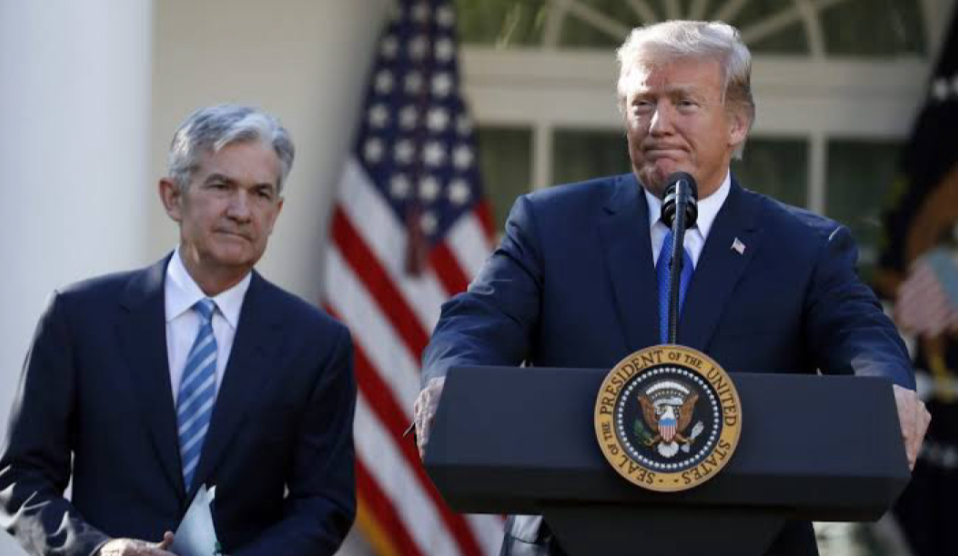
In a rare and emphatic public stance, the U.S. Federal Reserve has rejected growing calls from political figures including members of the Trump administration for pre-election interest rate cuts, reaffirming its independence and long-term economic mandate.
Fed Chair Jerome Powell, speaking at the Brookings Institution’s Monetary Policy Forum, stated that the central bank “will not adjust its policy path for short-term political convenience” and remains committed to taming inflation, which, though falling, remains above the Fed’s 2% target.
The remarks follow a string of public comments from former President Trump and top Republican lawmakers demanding immediate rate cuts to ease borrowing costs ahead of the November 2025 elections. Trump’s campaign has argued that high rates are “choking” small businesses and homebuyers, while some officials have floated legislation to review the Fed’s independence structure.
Inflation, Employment, and the Election Shadow
Recent inflation data show headline CPI falling to 3.1%, a marked improvement from the 9.2% peak in 2022 but still above the Fed’s target. Meanwhile, unemployment sits at 4.2%, with job growth softening in sectors like retail and manufacturing.
Despite these trends, Powell emphasized that a premature pivot in monetary policy could “undo hard-won gains” in price stability and “undermine long-term market trust in U.S. institutions.” He noted that the Fed is weighing a potential rate cut in early 2026, but only if inflation trends continue downward in a sustained manner.
The central bank’s benchmark rate remains at 5.25%, its highest level in over two decades, following an aggressive rate-hiking cycle that began in 2022.
Market Response and Political Fallout
Markets dipped slightly after Powell’s comments, with the S&P 500 closing down 0.8%, led by losses in rate-sensitive sectors like tech and housing. Bond yields rose modestly as investors recalibrated expectations for a 2025 rate cut.
Meanwhile, Trump-aligned media outlets and Republican PACs accused the Fed of “economic sabotage,” while Democrats defended the central bank’s independence as a cornerstone of modern U.S. governance. Some progressive economists, however, argue that the Fed’s policies are too conservative and risk tipping the economy into recession.
A Test of Institutional Resilience
The clash underscores a broader debate about the role of central banks in democratic societies. With populism rising on both ends of the spectrum, institutions like the Federal Reserve face increasing scrutiny and politicization.
“Fed independence is being stress-tested in real time,” said Danielle Kurtzleben, senior policy analyst at Brookings. “How it holds up will shape not just this election cycle, but the global perception of U.S. economic governance.”