BLAKSOLVENT FINANCE NEWS / 22-12-25
Shifting Currents: Policy Turns, Credit Moves, and Fragile Growth
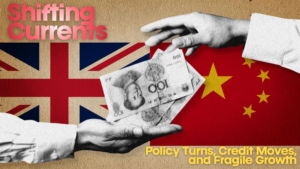
Governments and markets are navigating a dynamic financial landscape defined by monetary policy shifts, targeted credit reforms, and tentative signs of economic momentum. From Japan’s efforts to curb currency volatility amid unprecedented policy tightening, to China’s strategic credit repair initiative aimed at jumpstarting lending, and the United Kingdom’s modest economic growth in the face of persistent pressures, these developments highlight how fiscal and monetary decisions are shaping global finance. As policymakers balance inflation, credit access, and growth objectives, the interplay between investor responses and real-world outcomes remains central to the world’s economic path forward.
Japan Moves to Stabilize Markets as the Yen Weakens Sharply
BY BLAKSOLVENT NEWS
Japanese financial authorities issued a strong warning that they are prepared to take “appropriate action” against excessive movements in the foreign exchange market after the yen experienced sharp and one-sided weakness against major currencies. Government officials expressed concern that recent volatility especially the yen’s decline despite a recent Bank of Japan (BoJ) policy shift could unsettle financial markets and undermine economic stability. The cautionary statement followed after the BoJ raised its short-term interest rate to 0.75 %, the highest level in about 30 years, signaling a historic departure from decades of near-zero policy.
Despite the tighter monetary stance, markets saw the yen weaken further with the U.S. dollar strengthening above 157.00 yen prompting Japanese currency officials to publicly oppose what they described as speculative excesses. Treasury officials emphasized that currency moves should reflect underlying economic fundamentals rather than short-term market pressures, and reiterated that authorities would closely monitor developments and stand ready to intervene if needed.
Simultaneously, Japanese government bond (JGB) yields rose sharply, with the two-year yield setting a record high and the 10-year bond reaching its most elevated level in years. This dual trend higher yields and a weaker currency highlights the market’s complex response to tightening policy, where concerns about inflation, economic growth, and global capital flows are all factoring into investor behavior.
Market participants noted that volatility in the yen and JGB market could have broader implications for global risk sentiment, affecting carry trades and cross-border investment flows. Analysts underscored that if the government ultimately intervenes directly in FX markets, the move could set important precedents for future central bank policy coordination across major economies heading into 2026.
China Launches Credit Repair Initiative to Boost Lending
BY BLAKSOLVENT NEWS
In a bid to invigorate lending and stimulate broader economic growth, Chinese financial authorities announced a one-time credit repair program that will allow individuals to have small overdue debts removed from credit reports if those debts capped at 10,000 yuan (about $1,420) are fully repaid by March 31, 2026. The policy aims to improve borrowers’ creditworthiness and reduce long-lasting negative impacts from pandemic-era financial stress.
The initiative follows disappointing economic indicators in China, including weaker bank lending and sluggish retail sales, pointing to declining momentum in economic activity. Vice Governor of the People’s Bank of China, Zou Lan, framed the policy as part of a broader effort to support “high-quality growth and inclusive financial services,” particularly for low-income households and small enterprises that are often more constrained by credit barriers.
While the central bank maintained its benchmark lending rates unchanged for a seventh consecutive month in December, markets had anticipated potential rate cuts or reserve requirement ratio reductions to further stimulate credit demand. The latest move reflects a strategic pivot to address credit access more directly, rather than relying solely on traditional monetary policy tools.
Analysts say the credit repair policy could ease some pressure on consumer borrowing costs and foster renewed confidence among households and small business owners. Still, economists caution that deeper structural reforms including fiscal support and demand-stimulating measures may be required to fully reverse the broader slowdown and support stable growth into the coming year.
U.K. Economy Posts Modest Growth as Pressures Persist
BY BLAKSOLVENT NEWS
The Office for National Statistics reported that the United Kingdom’s economy expanded by 0.1% in the third quarter, a modest growth figure that underscores ongoing challenges in the economy as it navigates inflation, labor market dynamics, and global headwinds. The small uptick follows a period of stagnation and reflects the resilience of certain sectors even amid broader uncertainty in Europe’s economic landscape.
Detailed industry data showed that services and consumer spending contributed positively to GDP, offsetting weaker performance in manufacturing and export-oriented sectors. Analysts noted that the overall expansion while limited was a sign that the economy avoided contraction, although growth remains below historical averages and far from robust.
Government officials emphasized the importance of sustaining investment and productivity improvements, even as inflation and domestic cost pressures temper consumer confidence. Policymakers have signaled that targeted fiscal measures and support for business investment will be critical to keeping the economy on a stable trajectory.
Economists caution that external factors including global trade tensions, monetary policy shifts in major economies, and currency fluctuations could influence the U.K.’s performance in the near term. Close monitoring of labor markets, consumer demand, and capital investment flows will be essential for assessing the sustainability of future growth.