BLACKSOLVENT AI NEWS | 09/10/25
ARTIFICAL INTELLIGENCE: Power, Profit, and the Coming Reckoning
Artificial Intelligence is no longer an abstract experiment confined to research labs it is now the engine powering economies, driving innovation, and quietly rewriting global power structures. Yet behind the glamour of trillion-dollar valuations and futuristic promises lies a more complex reality: fierce infrastructure rivalries, financial instability warnings, and unseen cybersecurity threats. As governments, corporations, and financial institutions race to harness AI’s potential, the question that echoes across boardrooms and data centers alike is: How sustainable is this acceleration?
Three recent developments OpenAI’s strategic alliance with AMD, warnings from the Bank of England and IMF about an AI-driven market bubble, and a global spike in AI-related data breaches highlight the promise and peril defining this transformative moment.
The Hardware Gamble: OpenAI and AMD’s High-Stakes Alliance
BY BLACKSOLVENT NEWS
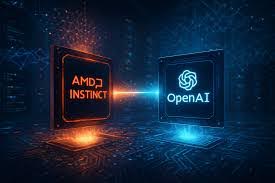
In early October 2025, OpenAI and AMD announced a partnership that could redefine the competitive map of the AI chip industry. The agreement involves deploying six gigawatts of AMD’s Instinct GPUs over the next few years, beginning with the MI450 series scheduled for rollout in 2026. This multi-billion-dollar deal grants OpenAI access to unprecedented computing power while AMD, in turn, offered up to 160 million share warrants, effectively tying its financial future to OpenAI’s performance.
At its core, this partnership is not just a business transaction it’s a statement of intent. For years, Nvidia has dominated the AI hardware space, its GPUs powering most large-scale training and inference systems. OpenAI’s pivot to AMD signals a deliberate diversification strategy, reducing dependency on one supplier and enabling deeper collaboration at the hardware-software level.
Industry analysts describe this as one of the largest infrastructure bets in the history of artificial intelligence. Six gigawatts of GPU capacity equates to the energy consumption of millions of homes a testament to the computational hunger of AI models that are growing exponentially in size and complexity.
Yet, this alliance is not without risk. Execution challenges loom large: supply chain management, thermal performance, energy sourcing, and data center scalability will determine whether the deal becomes a triumph or a cautionary tale. Analysts also note that the financial structure which effectively uses AMD’s own stock to subsidize the partnership introduces a degree of circular dependency that could prove volatile in unstable markets.
Nevertheless, Wall Street responded with enthusiasm. AMD’s shares spiked by over 20%, while OpenAI positioned itself as a long-term infrastructure player rather than a software-only entity. In a market defined by speed and scale, both companies are betting that synergy and vertical alignment will keep them at the frontier of the AI revolution.
The Bubble Beneath the Boom: Financial Institutions Raise Red Flags
BY BLACKSOLVENT NEWS
While corporate alliances shape the hardware front, global financial institutions are sounding alarms over the sustainability of the AI gold rush. The Bank of England’s Financial Policy Committee and the International Monetary Fund recently issued stark warnings: the market may be on the verge of an AI-driven bubble reminiscent of the early 2000s dot-com crash.
Their concern is rooted in valuation metrics. Tech and AI companies now make up nearly 40 percent of major global indices, with stock prices often based on speculative projections rather than tangible profits. The IMF cautioned that while AI’s long-term productivity potential is immense, near-term expectations have outpaced realistic gains.
The Bank of England warned that if investor sentiment turns sour due to regulatory pushback, slowing innovation, or political interference in central banks markets could face a sharp and painful correction. In essence, too much capital is chasing too little proven value.
Such warnings carry weight. Central banks rarely issue public statements about specific sectors unless they perceive systemic risk. The parallels to the dot-com era are striking: soaring valuations, venture-backed startups with uncertain revenue models, and widespread euphoria about a technology that promises to change everything.
For investors, this signals an impending reality check. AI remains transformative, but markets built on momentum and narrative are inherently fragile. The coming months may reveal which companies are genuinely building the future and which are merely floating on its hype.
Invisible Leaks: How AI Became the New Data Breach Frontier
BY BLACKSOLVENT NEWS

Beyond the boardrooms and trading floors, another quiet crisis is unfolding one that threatens corporate integrity and user privacy alike. A recent report by LayerX revealed that AI platforms have already become the number one channel for data leaks within enterprises.
The study found that 77% of sensitive data transfers to AI systems occur via simple copy-and-paste actions, and 67% of these interactions happen on unmanaged or personal accounts, completely outside official IT oversight. Employees feeding confidential data into generative AI tools from ChatGPT to Copilot are unintentionally creating invisible security gaps that traditional protection systems can’t detect.
Even more alarming is that roughly 40% of uploaded files contain personally identifiable information (PII) or financial data. Since generative AI tools process information via browser or API connections that appear “normal,” they bypass conventional firewalls and data loss prevention systems. In short, corporate security architectures weren’t built to handle this new mode of leakage.
This revelation marks a turning point in cybersecurity strategy. The line between productivity and risk is blurring rapidly, and organizations must adapt with policies that govern AI usage, employee education, and the adoption of AI-aware monitoring tools. The irony is clear: the same tools designed to boost efficiency may also become the Trojan horses that compromise it.