Building the Foundations of a Global AI Renaissance
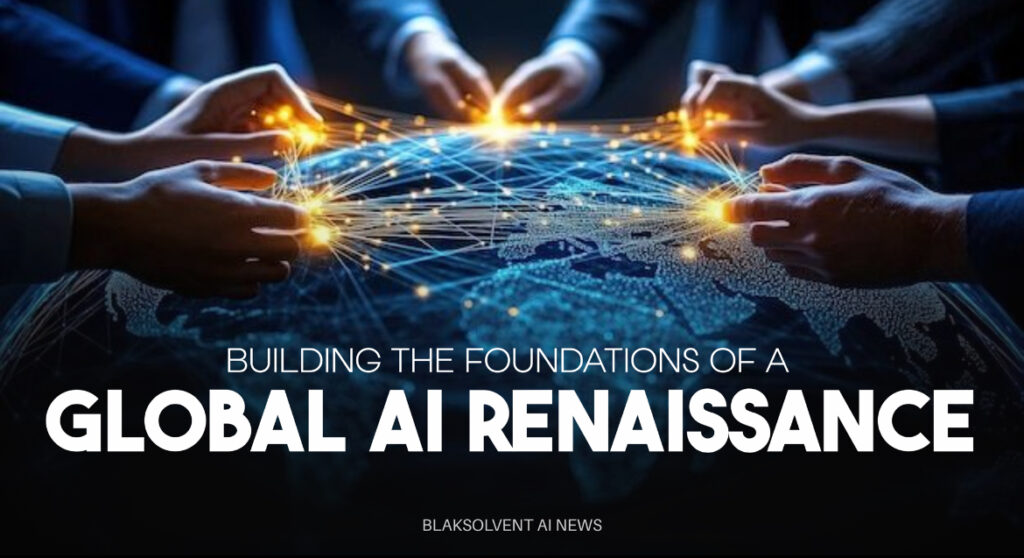
As innovation accelerates across continents and industries, we are entering a bold new era—one where artificial intelligence becomes not just a tool, but the backbone of global transformation.
This week’s developments reflect a powerful convergence:
- Oracle scaling the infrastructure to meet surging AI demand at enterprise levels
- Multiverse Computing redefining affordability and access with quantum-enhanced AI
- Visa and Microsoft investing in human capital to ignite fintech innovation in Africa
These aren’t isolated headlines—they are the early chapters of a global AI renaissance, rooted in shared ambition, cross-border collaboration, and the pursuit of scalable impact.
From Silicon Valley to Lagos, from Bilbao to Seattle, the message is clear: AI is not a distant luxury, but a present necessity. One that must be inclusive, ethical, and economically viable.
As Blacksolvent continues to spotlight the people and platforms pushing boundaries, we remain focused on one truth—those who empower others to build with AI will shape the world it creates.
Stay with us as we document this turning point—where code meets capital, and intelligence becomes the new infrastructure.
Oracle Soars as AI Cloud Momentum Drives Revenue Forecasts to New Highs

Shares of Oracle Corporation surged on Wednesday following an upbeat earnings report that revealed soaring demand for its AI-driven cloud services, significantly boosting the tech giant’s revenue outlook and reaffirming its positioning in the rapidly expanding enterprise cloud market.
The company’s stock rose more than 12% in early trading after Oracle reported a better-than-expected performance in its fiscal fourth quarter, fueled largely by corporate clients migrating their workloads to Oracle Cloud Infrastructure (OCI) to support artificial intelligence operations.
“Generative AI workloads are the fastest-growing demand driver we’ve ever seen,” said Oracle Chairman and CTO Larry Ellison during the earnings call. “AI developers require thousands of high-performance GPUs, and we are one of the few cloud providers that can deliver them efficiently at scale.”
🔹 Cloud and AI: A Winning Formula
Oracle reported a 17% year-over-year increase in cloud infrastructure revenue, highlighting continued acceleration in its Gen2 Cloud offerings. The company’s cloud applications and infrastructure business now accounts for the majority of its growth, overtaking legacy software license revenues.
This momentum has been significantly driven by Oracle’s strategic partnerships with major AI companies, including Cohere, NVIDIA, and OpenAI, which are using Oracle’s cloud platform to train large language models (LLMs) and deploy AI-powered enterprise solutions.
Oracle executives noted that the company’s data center capacity is being expanded aggressively to meet surging demand. Ellison revealed that Oracle has “orders for more cloud capacity than we can currently deliver,” prompting new builds across the U.S., Europe, and Asia.
🔹 Financial Highlights
- Q4 Revenue: $14.3 billion (up 9% YoY)
- Cloud Revenue: $6.7 billion (up 17% YoY)
- Operating Margin: Improved to 41%
- EPS: $1.78, beating Wall Street’s estimate of $1.65
The earnings beat has led Oracle to raise its guidance for fiscal 2026, projecting double-digit growth in cloud infrastructure and sustained demand for AI workloads, particularly in sectors such as healthcare, financial services, and manufacturing.
🔹 Investor Confidence and Market Reaction
Wall Street responded positively, with analysts praising Oracle’s ability to catch up with cloud leaders like Amazon Web Services (AWS) and Microsoft Azure by focusing on high-compute AI needs.
Wedbush analyst Dan Ives said in a note, “This is a landmark moment for Oracle. It has gone from a legacy software giant to a critical AI infrastructure player almost overnight.”
With investor confidence rising, Oracle’s market cap jumped by more than $40 billion, adding further weight to the company’s transformation narrative under Ellison and CEO Safra Catz.
🔹 Strategic Outlook
Looking ahead, Oracle is positioning itself as the preferred AI cloud provider for enterprises seeking specialized, high-performance solutions. The company emphasized that its Redwood AI services, which integrate AI into its enterprise SaaS platforms like ERP and HCM, will play a vital role in driving customer retention and expansion.
Oracle’s pivot toward AI and cloud computing continues to be one of the most significant transformations in the enterprise tech space, especially as companies race to integrate AI into every layer of their operations.
Multiverse Computing Secures $215M to Revolutionize Cost-Efficient AI, Enters Fierce Competition with SandboxAQ and Classiq
Quantum software pioneer Multiverse Computing has secured a massive $215 million Series B funding round, positioning itself as a disruptive force in the race to reduce the soaring costs of artificial intelligence deployment. The Spain-based startup is leveraging quantum and quantum-inspired computing to make AI more scalable and affordable—directly challenging heavyweight rivals like SandboxAQ and Classiq.
The funding round was led by European Innovation Council Fund, with strong participation from Quantonation, BBVA Spark, Redstone Quantum Fund, and other deep-tech backers. This marks one of the largest investments in a quantum-AI hybrid startup in Europe to date.
“This capital enables us to unlock new frontiers in AI efficiency and industrial scalability,” said CEO Enrique Lizaso Olmos. “We’re helping enterprises reduce AI compute costs by up to 80% using quantum-inspired methods that work today—without needing a full-scale quantum computer.”
🔹 A Quantum Leap in Practical AI
Multiverse Computing stands out by applying quantum algorithms to conventional hardware—a technique known as quantum-inspired optimization—to supercharge traditional machine learning models. This hybrid approach allows businesses to boost performance and accuracy while slashing costs associated with training large-scale AI systems.
The startup has already made waves in industries like finance, energy, and manufacturing, helping clients optimize fraud detection models, streamline supply chains, and power predictive maintenance tools.
Its flagship product, Singularity, enables quantum-enhanced machine learning on standard CPUs and GPUs, allowing companies to enjoy quantum-level gains without needing access to expensive or experimental quantum processors.
🔹 Funding Goals and Expansion Plans
According to the company, the $215 million will be channeled toward:
- Expanding its global engineering and R&D teams
- Scaling customer acquisition across North America, Asia, and Latin America
- Further developing proprietary algorithms that blend quantum math and generative AI
- Advancing collaborations with public sector and defense institutions exploring secure and energy-efficient AI
Multiverse is also setting up new hubs in Toronto, Berlin, and Singapore, as part of a broader push to attract top-tier talent and tap into emerging markets hungry for AI solutions that don’t break the bank.
🔹 Rivalry Heats Up: SandboxAQ and Classiq in the Crosshairs
By focusing on cost-effective AI at scale, Multiverse is entering direct competition with SandboxAQ—an Alphabet spinout using AI + quantum for cybersecurity and enterprise optimization—and Classiq, an Israeli firm building advanced quantum circuit design platforms.
While SandboxAQ focuses on quantum AI for secure communications and Classiq targets quantum hardware design, Multiverse is carving a unique space at the intersection of cost-efficiency and real-world readiness.
“The real battle isn’t who builds the first quantum computer,” said CTO Román Orús, “It’s who makes quantum and AI actually useful to business today. That’s where Multiverse wins.”
🔹 Market Impact and Analyst Perspective
Experts view Multiverse’s strategy as a smart pivot in a field often hampered by hype and long-term timelines. By emphasizing immediate commercial use cases, the company is gaining traction faster than many of its quantum-native competitors.
Forrester analyst Jodie Park commented, “Multiverse’s model addresses a critical pain point: AI’s infrastructure cost. Enterprises want results now—not a decade from now—and this approach brings quantum-enhanced benefits to today’s data centers.”
The quantum-AI convergence market is expected to reach $65 billion by 2030, and Multiverse’s fresh capital injection places it firmly on the map as one of Europe’s leading quantum AI companies.
Visa and Microsoft Unite to Supercharge Nigeria’s Fintech Growth Through AI Skills Development

In a bold move to accelerate Nigeria’s financial technology evolution, global tech giants Visa and Microsoft have announced a strategic partnership focused on empowering the country’s fintech ecosystem through AI-driven skills development. The initiative was unveiled during AI Skills Week Nigeria 2025, a national event designed to promote digital inclusion and future-ready workforces across the country.
This collaboration aims to close the talent gap in Nigeria’s fast-growing fintech sector by equipping startups, developers, and students with advanced artificial intelligence skills, tools, and mentorship.
“Our goal is to nurture the next generation of fintech leaders in Africa by giving them the tools to compete globally,” said Andrew Uaboi, Vice President and Head of Visa West Africa. “This partnership with Microsoft is a key step in building an inclusive, AI-powered financial ecosystem.”
🔹 Driving Innovation at the Intersection of Finance and AI
Nigeria’s fintech landscape has grown into one of Africa’s most vibrant tech sectors, attracting over $1.2 billion in investments in 2024 alone. However, talent shortages and limited access to advanced AI training continue to pose challenges for growth and sustainability.
To address this, Visa and Microsoft are rolling out joint training programs, including:
- Hands-on AI workshops and certifications tailored to fintech applications
- Mentorship sessions with global fintech and AI experts
- Access to Microsoft’s Azure AI platform and Visa’s fintech accelerator tools
- Real-world case studies and sandbox environments for startups to test solutions
These programs are targeted at early-stage fintech founders, developers, university students, and technical professionals seeking to upskill in areas like machine learning, predictive analytics, fraud prevention, and AI-enhanced customer service.
🔹 A Milestone Moment During AI Skills Week Nigeria
The announcement was made at the launch of AI Skills Week Nigeria 2025, hosted by Microsoft Africa Development Center in partnership with the Nigerian government and private sector stakeholders. The event brings together educators, policymakers, and industry leaders to discuss the role of AI in shaping Africa’s digital economy.
Olatomiwa Williams, Microsoft Country Manager for Nigeria, emphasized the importance of localized skill-building efforts:
“AI isn’t just a global trend—it’s a transformative force for Africa’s fintech future. Through our collaboration with Visa, we’re helping Nigeria lead the way in responsible, inclusive AI innovation.”
🔹 Supporting Nigeria’s Digital Transformation Agenda
This partnership aligns with Nigeria’s National Digital Economy Policy and Strategy, which seeks to promote innovation, entrepreneurship, and digital literacy across all sectors. By fusing AI capability with financial technology, Visa and Microsoft hope to accelerate access to financial services, particularly for underserved communities and SMEs.
The initiative is also expected to spark job creation and reduce the digital divide, especially as Nigerian fintech startups scale globally and seek to integrate AI into payments, lending, and digital banking solutions.
🔹 Industry Reaction and Future Outlook
Industry leaders welcomed the initiative as a critical leap toward sustainable fintech innovation. Many believe the collaboration can catalyze a ripple effect across other sectors such as healthtech, edtech, and agritech by laying a foundation for AI-first digital infrastructure.
Tosin Eniolorunda, CEO of fintech unicorn Moniepoint, noted: