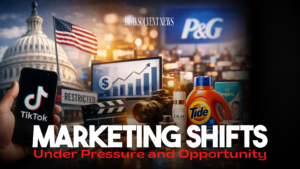
Marketing Shifts Under Pressure and Opportunity
Brands and platforms are navigating a landscape of regulatory scrutiny, changing consumer behavior, and strategic reinvention.
From social media transitions in the U.S. to record media spending, marketers are reassessing priorities.
Corporate giants like P&G are reimagining their approach to products and audience engagement.
These stories show how adaptability, investment, and innovation define marketing resilience today.
The industry is in motion, balancing risk, opportunity, and cultural relevance.
TikTok Navigates U.S. Transition Amid Regulatory Scrutiny

TikTok is undergoing a major transition in the United States, responding to mounting pressure over data security, content oversight, and ownership concerns. The platform, already a dominant force in social media engagement, now faces the challenge of aligning its operations with U.S. regulatory expectations while maintaining user growth.
The transition involves corporate restructuring, enhanced data handling protocols, and the potential formation of a separate U.S.-based entity. Officials in Washington have expressed concern about data access and algorithmic transparency, prompting TikTok to propose changes designed to reassure regulators and the public.
For marketers, the implications are immediate. U.S.-based campaigns must adapt to potential limitations on data usage and ad targeting. Brands that rely heavily on TikTok for audience engagement are recalibrating strategy while weighing the platform’s continued reach and influence.
From a user perspective, TikTok remains culturally relevant, with short-form video continuing to dominate trends in entertainment, commerce, and influencer activity. However, ongoing uncertainty could influence adoption, particularly among advertisers seeking stable platforms for campaigns.
Analysts note that TikTok’s transition could serve as a blueprint for other foreign-owned social media platforms navigating U.S. policy scrutiny. Success will depend on the platform’s ability to balance compliance with creative freedom, ensuring that the ecosystem remains attractive to content creators, advertisers, and users alike.
Ultimately, TikTok’s U.S. transition highlights the intersection of social media innovation, regulatory oversight, and corporate strategy in a highly visible, high-stakes environment.
Media Spending Hits Record Levels as Brands Chase Visibility

Global media spending has reached unprecedented levels, reflecting both competitive intensity and the central role of marketing in corporate strategy. Brands across industries are investing heavily in digital channels, television, and experiential campaigns, seeking to capture attention in a crowded and fragmented landscape.
Industry analysts point to several driving factors: post-pandemic economic rebound, the expansion of e-commerce, and the acceleration of digital transformation. Companies are prioritizing channels that allow precise measurement, audience targeting, and direct engagement, even at the expense of traditional media efficiency.
The rise in spending is accompanied by innovation in formats and creative execution. Short-form videos, immersive content, influencer partnerships, and interactive campaigns are reshaping how consumers experience brands. Agencies report increased demand for creative and analytics talent to optimize campaigns across platforms.
While record spending signals confidence, it also raises risks. Oversaturation, inflated costs, and shifting consumer attention pose challenges. Marketers must navigate the delicate balance between aggressive investment and audience fatigue, ensuring that campaigns remain relevant without overspending.
The surge also reflects a broader strategic mindset: marketing is no longer peripheral but a key driver of growth. Corporations are treating brand visibility as central to business resilience, particularly in competitive markets where early adoption of trends can yield outsized advantage.
In short, the record media spend is both a sign of opportunity and a cautionary reminder that investment must be paired with strategy, creativity, and agility to deliver meaningful returns.
P&G Reinvents Itself to Stay Relevant in a Changing Market

Procter & Gamble, the consumer goods giant, is undertaking a strategic reinvention to maintain relevance in an evolving marketplace. Faced with changing consumer expectations, digital disruption, and competitive pressure, P&G is rethinking product design, marketing, and distribution.
The company is emphasizing sustainability, personalized experiences, and direct-to-consumer channels. Products are being reformulated to appeal to younger demographics, while packaging and messaging are updated to reflect modern values. Marketing campaigns now leverage social media, influencers, and experiential activations to create engagement beyond traditional advertising.
Corporate restructuring accompanies this reinvention. P&G is streamlining operations, accelerating innovation, and fostering partnerships with tech companies and startups. By doing so, it aims to remain nimble despite its scale, adapting quickly to shifts in consumer preferences and market dynamics.
The reinvention also reflects lessons learned during recent global disruptions. Supply chain challenges, e-commerce growth, and the rise of conscious consumption have forced P&G to rethink risk, resilience, and relevance simultaneously.
For consumers, these changes are evident in product choices, online experiences, and brand communication. For competitors, P&G’s moves signal a renewed benchmark in agility, creativity, and market leadership.
Ultimately, P&G’s reinvention illustrates that even legacy brands must evolve continuously, balancing heritage with innovation to maintain trust, relevance, and growth in a competitive, fast-moving world.