BLACKSOLVENT STARTUP NEWS | 20.10.25
The Quiet Core of Transformation

In a moment when headlines celebrate flashy consumer apps and viral tech trends, a more significant reshaping is happening quietly, beneath the surface. Across three distinct arenas scientific discovery, infrastructure/compute, and culturally-anchored content startups are rewriting the bedrock of innovation. They aren’t just building new features or fresh apps; they are transforming how we discover, how we compute, and how we connect to culture and story. The lab benches where experiments used to be slow and manual are now becoming autonomous and robotic. The data-centres and warehouses once constrained by power and human labour are being redesigned with AI, architecture and vision. The media platforms that once spoke predominantly English and urban-centric are now adapting to regional languages, underserved audiences and new formats. Together, these three stories signal that the future doesn’t always arrive loudly it often whispers through subtle shifts in where value is built, not necessarily where it is sold. For founders, investors and ecosystem builders (especially in emerging markets), the insight is this: the biggest opportunities may lie not at the user interface layer, but deeper at the foundations of process, hardware, supply-chain, culture and localisation.
Space-Enabled Drug Manufacturing: Varda Space Industries
BY BLACKSOLVENT NEWS

Varda Space Industries, based in El Segundo, California, recently announced a US $187 million Series C funding round, which brings the company’s total funding to about US $329 million.
Founded in 2021 by former aerospace and venture-capital veterans (including one ex-SpaceX engineer and a partner from Founders Fund), Varda is pursuing what amounts to a radical redefine of pharmaceutical manufacturing: move it into space. The company builds unmanned re-entry capsules that launch into low Earth orbit, manufacture or process pharmaceutical crystals in microgravity, then return to Earth to recover those crystals for further development.
Why does this matter? On Earth, gravity influences how crystals grow — their form, structure, orientation, purity. In microgravity, many of those constraints vanish or change, enabling potentially novel formulations of active pharmaceutical ingredients (APIs) — formulations that might be more stable, more efficient, or serve routes of administration previously impossible. Varda reports one early success: its payload achieved crystallisation of the anti-HIV drug ritonavir in orbit, which returned to Earth intact.
With the new capital, Varda plans to accelerate its launch cadence (aiming for more frequent missions), build out ground-based laboratory expansions (including a larger lab in El Segundo and a facility in Huntsville, Alabama) to screen candidates for orbit, and scale the business proposition from “demonstration” toward commercial contracts with pharma companies.
Implications for emerging markets: This startup serves as a vivid example of building infrastructure at a layer deeper than just apps: manufacturing environment, materials science, industrial-scale systems. For entrepreneurs in Africa or other regions, the lesson is that true differentiation may come from rethinking where and how things are produced — not only what is produced. Of course the challenge here is enormous: cost of launches, regulatory complexity (launch/re-entry licences), client acquisition in the pharmaceutical industry, supply-chain and product validation. But the ambition, and the funding showing, underscore a shift where “labs in space” go from sci-fi to real industrial strategy.
Warehouse & Logistics Reinvented: DexorY.
By Blacksolvent News
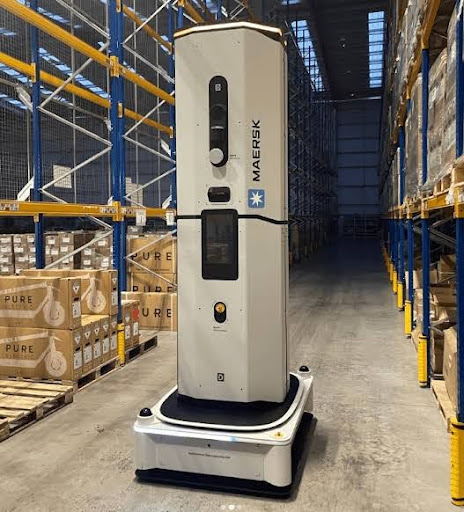
Dexory, a UK-based robotics and data-intelligence company founded by Romanian engineers (Andrei Danescu, Oana Jinga and Adrian Negoita) has raised US $165 million in its latest funding round — making it a major leap for a logistics-hardware/AI company.
The company builds autonomous robots that operate in large-scale warehouses — some of their robots can scan inventory on racks up to 15 metres high. These robots navigate aisles, use sensors and vision systems to collect data (pallet counts, space utilisation, stock status) and feed a software-as-a-service platform called “Dexory View” that gives real-time analytics and insights to logistics and manufacturing clients (including major names such as GXO, Maersk, DHL and Stellantis).
The recent funding will be used to accelerate expansion: Dexory plans to open a flagship facility in North America, increase global deployment of its robot fleets, deepen its AI/analytics stack, and strengthen its hardware-manufacturing and service operations. The round included a mix of equity (~US $100 million) and debt (~US $65 million) and brings total funding to about US $270 million for the company.
Why this is important: In the logistics and warehouse domain, efficiency has long been constrained by manual scanning, manual stock-taking, human inspections and data delays. By embedding robotics + intelligence into this “plumbing” of commerce, Dexory is rewriting how goods move, how inventory is managed, how space is used. For emerging markets such as Nigeria and Africa broadly, where e-commerce and supply-chain growth are increasing but infrastructure lags, solutions like this offer leap-frog potential. Automating warehouse inventory, real-time analytics and robotics could raise productivity, reduce errors, optimise space and cut cost. The challenge for local markets: adapting robotics to local warehouse setups, managing service and maintenance, ensuring business models work at lower scale or with different cost structures. But Dexory’s journey shows that the frontier is not only front-end apps it’s robotics + hardware + data in real-world commerce.
Vernacular Content Platform Kuku FM Raises US$85 Million to Scale Local Storytelling
BY BLACKSOLVENT NEWS

India-based content startup Kuku FM, backed by Granite Asia, has secured US$85 million in a Series C funding round. The investment, announced in October 2025, values the company at around US$550 million post-money.
Kuku FM began in 2018 as an audio-first platform offering audiobooks and original shows in multiple Indian languages; it has since expanded into “Kuku TV”, a vertical micro-drama video app, and continues to serve over ten million paid subscribers.
The new funding will support the company’s strategy to: deepen AI and data infrastructure (including an in-house generative-AI studio for multilingual scripts, translation and ad creation), ramp up creator partnerships (including well-known actors and television personalities), increase production of localised content in multiple languages, boost international expansion pilot efforts, and accelerate monetisation via subscription, ads and creator-economy payouts.
Kuku FM’s business model reflects a strong local-language, mobile-first focus leveraging India’s massive smartphone penetration, low data cost environment, and the rising appetite for native-language fiction, podcasts and short-form video. Analysts estimate the mobile-first Indian short-form audio-video market could reach multi-billion-dollar size in a few years.
For founders in emerging markets (including Africa), the lessons are clear: one, large addressable audiences still exist beyond English-language platforms; two, local culture, local language, and format-adaptation matter; three, investing in the infrastructure (AI/data tools for production, creator ecosystem) enables scale and differentiation. The challenge ahead will be balancing high content-creation cost, competition (both local rivals and global entrants), platform moderation/copyright issues, and converting large user bases into profitable business models in lower-ARPU markets.