BLAKSOLVENT GÉNÉRAL NEWS | 16TH SEPTEMBER,2025
Shadows of Strain in Policy and Markets
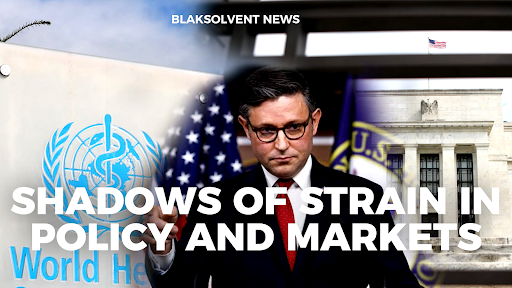
In Washington and beyond, the past week revealed just how tightly politics, economics, and public health are woven into the global fabric. From the halls of Congress, where lawmakers spar over stopgap funding and heightened security measures, to the financial markets, where banks tapped record sums from the Federal Reserve’s repo facility to ease short-term liquidity stress, the signals are clear: institutions are under pressure to adapt quickly to evolving risks. At the same time, the World Health Organization’s call for a new mindset on obesity treating it as a chronic disease and backing long-term drug treatments underscores the urgency of reframing challenges that affect millions worldwide. Taken together, these stories highlight a landscape where resilience depends not only on policy decisions but also on the willingness to confront deep-rooted issues in finance, governance, and health.
WHO Backs GLP-1 Drugs for Long-Term Obesity Treatment, Urges Global Mindset Change .
BY BLAKSOLVENT NEWS
The World Health Organization (WHO) has proposed a significant shift in global obesity treatment. In newly published draft guidelines, now open for public feedback through September 27, the WHO recommends using GLP-1 medications—such as those made by Novo Nordisk and Eli Lilly—for the long-term treatment of obesity in adults with a Body Mass Index (BMI) of 30 or higher.
For years, obesity has largely been framed by many governments and health systems as a lifestyle issue: something to be managed by diet, exercise, and personal responsibility. The WHO’s guidance reframes it as a chronic, progressive, and relapsing disease one that affects over one billion people globally, in both high-income and low- and middle-income countries, and contributes to “millions of preventable deaths.”
According to the draft guidance, GLP-1 drugs would not replace lifestyle changes like nutrition, physical activity, and behavioral counseling but instead be used alongside them. These drugs work by mimicking a gut hormone that helps suppress appetite, slow digestion, improve feelings of fullness, and in clinical use have shown benefits for weight loss and metabolic health.
However, the WHO stopped short of adding these GLP-1 weight-loss drugs to its Essential Medicines List for obesity treatment. The main barriers: high costs and limited access in poorer countries. While these medications are now included in the essential medicines list for certain uses (notably for type 2 diabetes combined with other conditions), many low- and middle-income countries may struggle to afford them under current pricing.
The document also signals that separate guidelines are being developed for children and adolescents, recognizing that obesity isn’t just an adult issue and that younger age groups face their own health risks and treatment considerations.
Public health experts see the WHO’s move as a turning point. If adopted, these guidelines could lead to changes in national health policies, insurance coverage rules, and funding priorities. They may also ignite debates over affordability, equity, and how to ensure treatment access across different countries. For many patients, the move offers promise: recognition at the highest global level that obesity demands medical care, not just lifestyle advice.
- Banks Tap Record $18.5 Billion from Fed Repo Facility, Signaling Funding Stress
BY BLAKSOLVENT NEWS
On September 15, 2025, U.S. banks borrowed a record $18.5 billion from the Federal Reserve’s Standing Repo Facility (SRF), as financial institutions scrambled to meet large cash obligations tied to quarterly corporate tax payments and major Treasury debt settlements.
Of that total, roughly $1.5 billion was borrowed in the morning session and a much larger $16.95 billion was drawn in the afternoon, both loans secured by U.S. Treasuries. The borrowing far exceeded the end-of-June usage of about $11.1 billion, setting a new high for strains in short-term funding markets.
The pull on liquidity came at a time when the U.S. Treasury was expected to disburse approximately $78 billion in payments, including from debt issuances and other large obligations, pushing its cash balance toward and above $870 billion.
Analysts said that the episode signals some tightness in financial markets particularly in secured funding markets but they were quick to caution that this was not a full-blown crisis. The factors driving stress were largely predictable: the confluence of tax deadlines, large Treasury settlements, and elevated demand for secured funding collateralized by Treasuries.
One vivid measure of the stress: the Secured Overnight Financing Rate (SOFR), which reflects the cost of borrowing cash overnight using Treasuries as collateral, rose to 4.42%. That rate now edges above the Fed’s Interest on Reserve Balances (IORB), which stands around 4.40%. When SOFR moves above IORB, it often signals heightened demand for short-term secured cash because banks find it more profitable (or necessary) to borrow rather than simply keep excess reserves at the Fed.
Market observers noted that such patterns are typical during days involving large payment settlements or tax obligations. After these events pass, funding conditions tend to relax. For now, many believe this liquidity squeeze is temporary and contained.
U.S. House Speaker: Stopgap Funding Bill Hindered by Security Funding Demands.
BY BLAKSOLVENT NEWS
Washington, D.C. — Negotiations over a stopgap government funding measure have hit a snag as lawmakers argue over how much additional money should be included to protect federal officials, judges, and members of Congress. With the current funding deadline looming, the impasse is adding urgency to already tense budget talks in Congress.
House Speaker Mike Johnson said discussions on the continuing resolution (CR), a short-term funding extension intended to avoid a partial government shutdown beginning October 1 have been “complicated” by demands to expand security funding in response to escalating threats. The need for enhanced protection followed recent high-profile incidents, including the killing of conservative activist Charlie Kirk, which have heightened concerns over safety for public officials.
Lawmakers are working out what level of funding would be appropriate. Johnson indicated that they must balance the urgency of protecting judges, members of Congress, and executive branch officials with the need to keep the resolution limited in scope. He said he expects agreement in the next 24 to 48 hours.
Senate Republican Leader John Thune has expressed openness to using the CR as a vehicle to include the added security spending, but he has stressed that overall increases in spending should be minimal. The draft CR under discussion would maintain government funding at current levels and extend it through November 20, allowing more time for full fiscal year appropriations to be worked out.
However, some Democrats criticize the proposals, arguing that the CR omits other priorities such as healthcare provisions specifically, extensions of enhanced Affordable Care Act tax credits. They contend that limiting the bill to security funding without addressing other pending issues risks politicizing fundamental services. Speaker Johnson has pushed back, accusing Democrats of politicizing the process and emphasizing his goal of keeping the CR narrowly tailored.
With Congress preparing to recess soon, there is pressure to finalize the deal quickly to avoid shutdown disruptions. A shutdown would potentially halt many federal agencies and services, furlough workers, and create uncertainty across governmental operations. All parties acknowledge this, making the security demand a pivotal sticking point in what otherwise might have been a routine stopgap measure.