A Pulse on Global Innovation — Nigeria, India, and Termina’s Energy Revolution
As the second quarter of 2025 begins, a common thread runs through the heart of innovation across continents — resilience, reinvention, and purpose-driven capital. From Lagos to New Delhi and Silicon Valley, these three stories reflect the enduring vitality of startups in solving complex challenges, even in the face of a cautious global investment landscape.
Termina’s $3 million pre-Series A round, backed by EVP, is more than a vote of confidence in clean energy; it’s a signal that energy transition solutions tailored for small businesses are gaining traction with serious investors. In a world prioritizing sustainability, Termina’s model — which blends decarbonization, energy analytics, and financial ROI — could redefine how Main Street participates in climate action.
Meanwhile, India’s crossing of the $1 billion startup funding threshold in May — propelled by healthtech and logistics — speaks volumes about the country’s capacity to build for scale in sectors tied directly to human welfare and infrastructure. The funding revival not only strengthens India’s place as a global startup hub, but also points to the enduring appeal of grounded, tech-enabled services in massive, underserved markets.
Back in Africa, Nigeria’s startups raised over $160 million in Q1, showcasing a startup ecosystem that refuses to be defined by macroeconomic headwinds. In fintech, mobility, and health, Nigerian founders are building practical, continent-first innovations that speak to the realities of life on the ground — and they’re attracting capital from both local and international backers who see long-term potential.
Together, these stories paint a powerful picture: investors are no longer simply chasing scale — they’re chasing solutions. Whether it’s cleaner power for small businesses, AI-powered healthcare diagnostics, or tech-enabled logistics across emerging economies, the next wave of global startup growth is being shaped not just by capital, but by clarity of purpose.
As these ventures evolve and scale, they not only redefine markets — they reshape the future of how we live, work, move, and power our world. At Blacksolvent, we remain committed to following these journeys, spotlighting the people, capital, and ideas driving meaningful transformation across borders.
Termina Secures $3M in Pre-Series A Round Backed by EVP to Advance Small Business Energy Solutions

Energy innovation startup Termina has raised $3 million in a pre-Series A funding round, with EVP (Energy Ventures Partners) taking the lead as the primary investor. The investment marks a pivotal moment for the company, which is focused on helping small and medium-sized enterprises (SMEs) reduce energy consumption and improve efficiency through affordable, AI-powered energy management solutions.
Fueling the Future of Sustainable Business
Founded in 2022, Termina has positioned itself as a disruptor in the commercial energy tech space. The company’s platform offers real-time monitoring, predictive maintenance alerts, and customized recommendations that enable small businesses to cut down on electricity bills and optimize their energy usage without needing deep technical knowledge or major infrastructure changes.
“Our mission has always been to empower small businesses with tools typically reserved for large enterprises,” said Temi Aluko, CEO and co-founder of Termina. “This funding from EVP not only validates our vision but also gives us the resources to scale and make a deeper impact in underserved markets.”
EVP Backs Smart Energy Transition
EVP, known for its strategic focus on cleantech and decarbonization startups, said the decision to back Termina was based on both the company’s early traction and its potential to democratize access to smart energy tools.
“We see Termina as a key enabler of energy equity for small businesses, especially in emerging markets,” said Linda Ofori, Partner at EVP. “The platform is not only scalable but also deeply aligned with our mandate to invest in technologies that drive down energy costs and carbon footprints.”
Expansion Plans and Product Roadmap
With the new funding, Termina plans to accelerate its go-to-market efforts across Sub-Saharan Africa and expand into select Southeast Asian markets by Q1 2026. The company also aims to invest in R&D to enhance its proprietary AI algorithms, which currently analyze real-time energy data to provide actionable insights.
Aluko confirmed that the funds would also support the launch of Termina Lite, a more affordable, plug-and-play version of its energy monitoring system tailored for microenterprises and kiosks.
Market Momentum and Growing Demand
As energy costs continue to rise globally, small businesses—often the most vulnerable segment—are actively seeking tools to stay afloat and competitive. Termina has already onboarded over 2,500 SMEs across Nigeria, Kenya, and Ghana since its soft launch in late 2023, with 87% reporting double-digit savings on monthly electricity costs.
Analysts believe that startups like Termina are poised to play a significant role in helping emerging economies meet both sustainability and financial inclusion goals.
Looking Ahead
With EVP’s strategic capital and mentorship, Termina is expected to deepen its product offerings, expand its market reach, and potentially enter into public-private partnerships to scale impact.
“This is just the beginning,” said Aluko. “We’re building a future where energy savings are not a luxury, but a right accessible to every business, big or small.”
About Termina
Termina is an energy technology startup that provides AI-driven solutions to help small businesses monitor, manage, and optimize their energy consumption. The company is headquartered in Lagos, Nigeria, and serves a growing customer base across Africa and beyond.
About EVP (Energy Ventures Partners)
EVP is a venture capital firm focused on investing in startups that are accelerating the global transition to sustainable energy. The firm backs early- and growth-stage companies across cleantech, energy efficiency, and grid innovation sectors.
Indian Startup Funding Surges Past $1 Billion in May, Driven by Healthtech and Logistics Boom
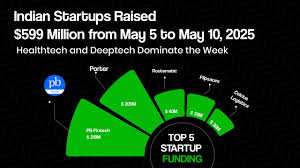
New Delhi, India – In a strong rebound for India’s startup ecosystem, venture funding in May 2025 surpassed the $1 billion mark, with healthtech and logistics startups emerging as the top drivers of investment momentum. This marks the highest monthly funding total in over six months, signaling renewed investor confidence and sectoral growth across digital healthcare and supply chain infrastructure.
Sectoral Surge Leads the Charge
Healthtech startups led the funding tally with several major rounds, including a $120 million Series D secured by telemedicine leader CuraNow, and a $65 million Series B by diagnostic AI startup Medvantage. The surge reflects strong post-pandemic interest in AI-powered diagnostics, remote care platforms, and personalized medicine, especially as healthcare digitization becomes a core policy and market theme in India.
Logistics also saw a sharp rise, with investments totaling over $250 million across both B2B and last-mile delivery platforms. Notable deals included SpeedKart’s $90 million Series C and a $55 million infusion into warehousing automation startup StackGrid.
Investor Optimism Returns
According to data compiled by Blacksolvent from Tracxn and industry insiders, more than 75 deals were closed in May, involving a mix of late-stage rounds and early-stage seed investments. Key global and domestic investors participating included Sequoia Capital India, Accel, Nexus Venture Partners, and Tiger Global.
“May’s rebound is a sign of resilience and recalibration,” said Anirudh Rao, a venture analyst at Mumbai-based EquiEdge Capital. “Healthtech and logistics are showing strong fundamentals—solid unit economics, proven models, and scalable demand—which makes them attractive in an otherwise cautious funding environment.”
Early-Stage Startups Gain Ground
Interestingly, pre-seed and seed-stage startups also witnessed increased activity, especially in fintech, agri-tech, and climate-focused ventures. Roughly $150 million of the total funding volume came from startups raising under $5 million, indicating investor appetite for next-generation solutions with long-term potential.
Regulatory and Market Tailwinds
The uptick in funding has also been fueled by positive regulatory signals. The Indian government’s Startup India mission, new PLI schemes, and healthtech interoperability policies have helped reduce investor risk and enhance startup viability. Additionally, rising urbanization and e-commerce demand are sustaining interest in logistics and mobility.
Outlook for the Second Half of 2025
Market analysts predict that the Indian startup ecosystem could close Q2 2025 with $2.5–3 billion in total funding, especially if macroeconomic indicators continue to stabilize and global capital flows remain strong.
“There’s a cautious optimism,” said Ritika Sharma, a partner at VentureSphere India. “Investors are no longer writing blank checks, but they are definitely backing bold, high-impact models—particularly in health, logistics, and climate tech.”
Funding Snapshot – May 2025 Highlights
- Total Startup Funding: $1.04 billion
- Top Sector: Healthtech (~$400 million)
- Second-Best Performer: Logistics & Supply Chain (~$250 million)
- Top Deals:
- CuraNow (Healthtech) – $120M Series D
- SpeedKart (Logistics) – $90M Series C
- Medvantage (Health AI) – $65M Series B
- StackGrid (Warehouse Tech) – $55M
- CuraNow (Healthtech) – $120M Series D
- Active Investors: Sequoia Capital, Accel, Nexus, Tiger Global.
Nigerian Startups Raise Over $160 Million in Q1 2025, Led by Fintech and Mobility Deals

Lagos, Nigeria – Despite global economic uncertainty and tighter venture capital flows, Nigerian startups managed to raise over $160 million in the first quarter of 2025. The funding, distributed across several high-impact sectors, was largely driven by major deals in mobility fintech, financial services, and logistics — solidifying Nigeria’s role as a regional tech powerhouse in Africa.
At the top of the funding chart was Moove, a mobility fintech startup that raised a staggering $100 million round led by Uber and backed by Mubadala. Moove plans to use the capital to expand its vehicle financing and fleet management offerings for ride-hailing and logistics operators in emerging markets, further deepening its penetration in Africa and the Middle East.
Another major highlight came from Moniepoint, formerly known as TeamApt, which secured a $110 million Series C round. This funding round propelled the company into unicorn status, valuing it at over $1 billion. Investors included Development Partners International’s ADP III fund, Google’s Africa Investment Fund, and Verod Capital, with the funds earmarked for expanding its suite of digital financial services to small and medium enterprises (SMEs) across Africa.
Other noteworthy deals include Raenest, which raised $11 million to scale its payment and payroll tools for freelancers and remote teams, and Tether, which secured $10 million through a combination of seed investment and debt financing to grow its digital payment infrastructure.
Shekel Mobility, an auto marketplace for car dealers, brought in $9.15 million in equity and debt to build out its tech stack and strengthen its market presence. Similarly, Terragon, a data and marketing analytics platform, raised $9 million in a Series B round led by Orange Ventures to support its cloud marketing services and product development.
Meanwhile, Traction, a digital payment and business solutions provider, closed a $6 million seed round with plans to expand its footprint beyond Nigeria. In the health sector, Remedial Health raised $12 million to further digitize pharmacy operations and improve pharmaceutical supply chains across West Africa.
Fintech startup FrontEdge also drew attention with a $10 million round aimed at improving cross-border trade and connecting African SMEs to global markets. Rounding out the list is Waza, a B2B payment and liquidity platform, which secured $8 million to enhance its trade finance offerings and extend its reach across Africa.
While fintech remained a major contributor to the Q1 funding total, logistics and mobility were the standout sectors, accounting for approximately $151 million in 14 transactions. This continued investor confidence highlights the growing demand for efficient transportation, warehousing, and delivery services in Nigeria’s rapidly urbanizing landscape.
Despite a global funding downturn, Nigeria’s startup scene is showing strong resilience. Many of the companies securing funding in Q1 are addressing real infrastructural gaps — from financing and transportation to healthcare access and digital tools for SMEs. Analysts believe this signals a shift from hype-driven investment to more impact-focused, revenue-generating models.
As the rest of 2025 unfolds, investors are expected to continue backing Nigerian startups that offer scalable solutions with long-term economic and social value. With several later-stage rounds already in the pipeline, Q2 could see even greater funding momentum if market conditions remain favorable.